
Something shifted in the e-bike industry over the last two years, and it didn’t come with a press release.
The motors got smarter.
Not incrementally smarter — fundamentally smarter. The difference between riding a high-end e-bike in 2023 and riding one today isn’t about wattage or battery capacity. It’s about what’s happening inside the motor controller during the ride. Decisions are being made thousands of times per second that the rider never consciously triggers and never manually overrides. The bike is reading the terrain, reading the rider, and adjusting — constantly, invisibly, without interruption.
That’s AI. Not the chatbot kind. The embedded, real-time, sensor-driven kind that runs on a chip smaller than your thumbnail and determines whether a ride feels like flying or fighting.
This article explains what that actually looks like across every system it touches — power delivery, battery management, maintenance, security, and what’s coming next.
01 First, What “AI” Actually Means Here
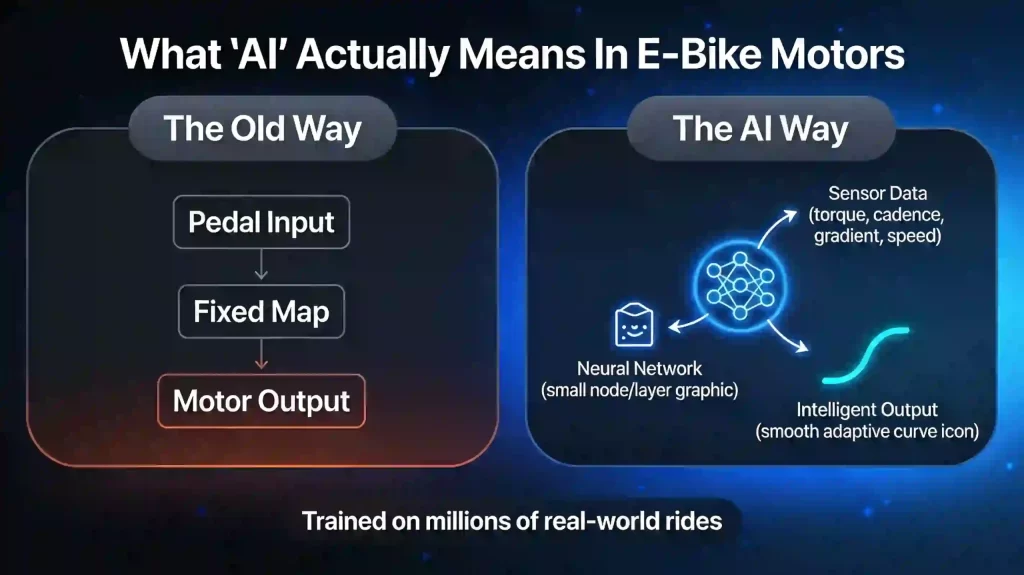
The word gets misused constantly in this industry, so it’s worth being precise.
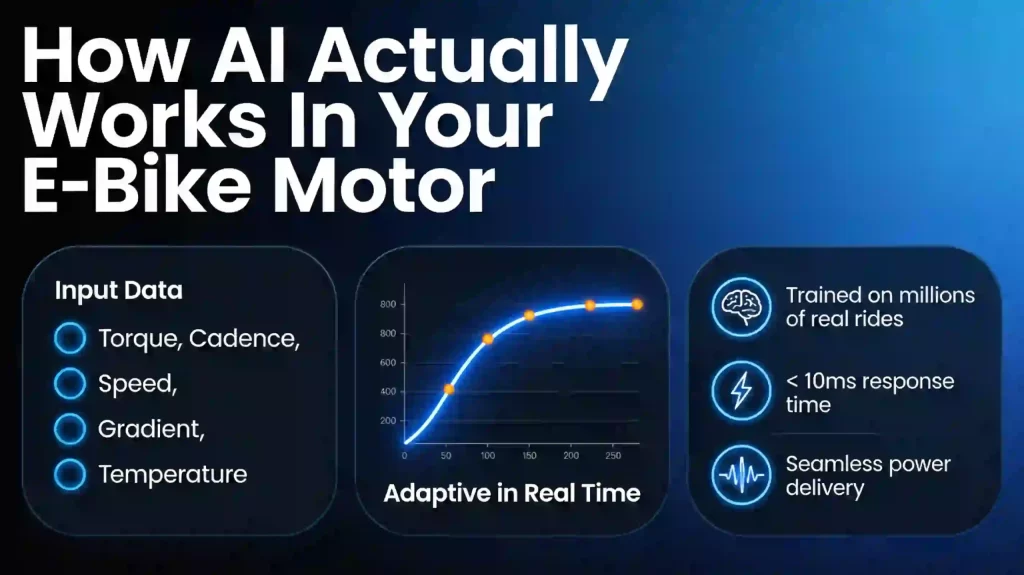
When we talk about AI in e-bike motor systems, we’re talking about machine learning algorithms trained on real-world riding data — millions of data points from real terrain, real riders, real conditions — that run as firmware on the motor controller. These algorithms have learned to recognize patterns: what a steep gradient looks like in torque data, what a headwind feels like in cadence and speed readings, what the difference is between a rider pushing hard up a climb and a rider cruising comfortably on flat ground.
At the basic implementation level, this means better-tuned assist curves that respond more naturally than anything achievable through manual calibration. At the advanced end, it means systems that build an individualized model of each specific rider over time — learning your cadence preferences, your fitness level, your typical routes — and personalizing assist behavior accordingly.
✅ The Core Difference
The fundamental shift is this: the motor is no longer just responding to inputs. It’s interpreting them. That distinction sounds subtle. The riding experience it produces is anything but.
02 Adaptive Power Management: Why Fixed Modes Are Becoming Obsolete
Pick up any e-bike from five years ago. Turn it on. Select “eco” or “sport” or “turbo.” Notice what happens — the motor delivers a predetermined percentage of assistance based on your cadence, regardless of whether you’re climbing, descending, fighting a headwind, or cruising on flat tarmac.
That’s the entire system. A fixed rule applied uniformly to every situation. It works. It’s just not very good.
⚠️ The Flaw In Static Modes
Cycling is a dynamic activity. Gradient changes constantly. Wind direction shifts. Your effort level fluctuates. A fixed assist mode that’s appropriate for one section of a ride is either wasteful or insufficient for every other section. You end up manually switching modes every few minutes on technical terrain, which defeats much of the purpose of having assist at all.
AI-driven adaptive power management treats power delivery as a continuous optimization problem. The controller reads torque at the crank, cadence, wheel speed, incline from the accelerometer, motor temperature, battery state — all simultaneously, all the time. It builds a real-time picture of the current riding situation and adjusts output accordingly, before the rider consciously registers the terrain change.
The practical experience of this is difficult to describe accurately until you’ve felt it. You crest a climb and the power backs off cleanly, without a jolt. You hit a descent and the system eases off without you touching anything. You start pushing harder into a headwind and the assist rises to match you. Nothing is manual. Nothing is jarring. The motor just… keeps up.
From an efficiency standpoint, the gains are real and measurable. Intelligent energy management — the AI deciding when to be generous and when to hold back — extends usable range compared to static modes because it eliminates the constant small inefficiencies of a fixed system responding blindly to conditions it doesn’t understand. Bosch’s Range Control feature within their eBike Flow platform is one of the clearest production examples of this working at scale: the system calculates the energy budget required to complete a planned route and modulates assist across the entire ride to ensure the battery arrives at the destination with an appropriate reserve. It’s not limiting performance. It’s spending power intelligently.
For riders doing technical terrain — trail riding, loaded touring, aggressive commuting in hilly cities — the difference in day-to-day usability is significant.
03 The Motor Controller: Where The Intelligence Actually Lives
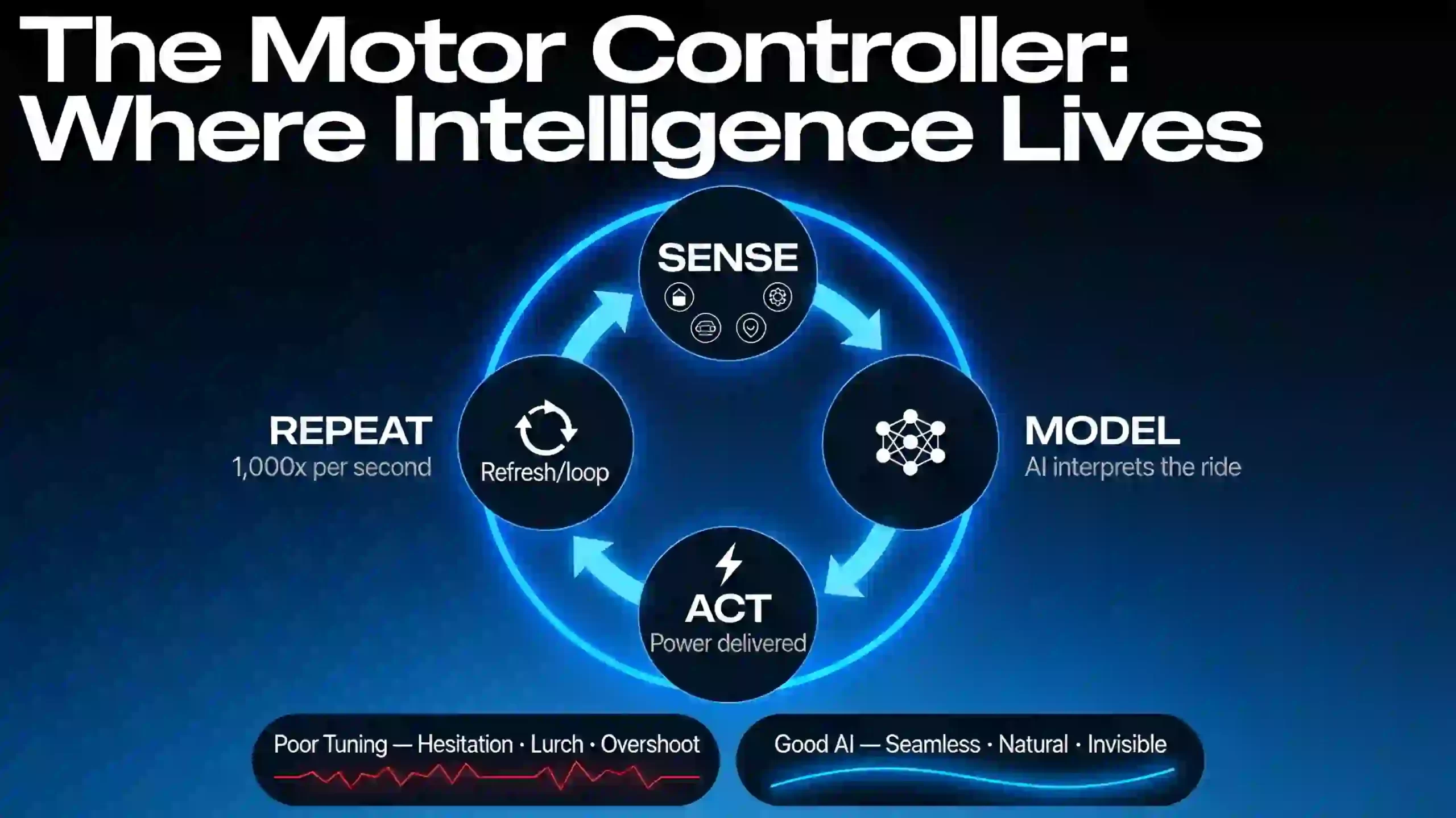
Most people thinking about “smart e-bikes” picture the app. The handlebar display. The connectivity features. These are visible and easy to demonstrate, which is why they dominate marketing.
They’re also not where the intelligence is.
The actual AI runs on the motor controller — a compact piece of hardware that sits between the battery and the motor and handles every aspect of power delivery. In a basic system, the controller follows simple rules: more pedaling input, more motor output, up to the mode ceiling. In an AI-driven system, the controller runs a continuously updated model of the ride and uses that model to calculate optimal output for the next few milliseconds.
Sensors Feeding The AI Architecture:
- Torque Sensor: Mounted at the crank to read exact pedaling pressure.
- Cadence Sensor: Located on the bottom bracket.
- Speed Sensor: Mounted at the wheel.
- Accelerometer: Measuring orientation, incline, and movement in three dimensions.
- Temperature Sensors: Monitoring the motor and battery limits.
- Current & Voltage Sensors: Tracking real-time power draw and individual battery cell states in advanced systems.
The controller fuses all of this into a coherent picture of what’s happening and what should happen next. Then it acts. Then it does it again. Thousands of times per second, for the entire ride.
What separates good implementations from poor ones is the quality of this decision loop — how accurately the model interprets the sensor data, how quickly it responds, how naturally the output translates into something the rider feels as assistance rather than intervention. A well-calibrated AI controller produces assist that feels like an extension of the rider’s own effort. A poorly tuned one announces itself as a machine: hesitation when you start pedaling, a lurch on gradient changes, an overshoot when you crest a hill.
This is why firmware has become as competitively important as hardware. Two bikes with identical physical motors can ride completely differently depending on the intelligence running on the controller. And manufacturers can improve that intelligence in bikes already in the field through over-the-air updates — no hardware changes, no workshop visit, just a better ride delivered while the bike sits in your hallway charging overnight.
04 Why Mid-Drive Architecture Gives AI Better Data

Not all motor configurations provide equally good data to the AI system, and this is a technical distinction with significant real-world consequences.
Hub Motors vs. Mid-Drive Motors
- Hub Motors (Front/Rear Wheel): Typically measure the rider’s input indirectly. The controller infers pedaling force from motor current draw, or receives data from sensors mounted elsewhere on the bike and transmitted wirelessly. Both approaches introduce latency and measurement uncertainty. The AI is working with an approximation.
- Mid-Drive Motors (Bottom Bracket): Mechanically connected directly to the drivetrain at the crank. The torque sensor measures the rider’s actual pedaling force at the source — the exact point where effort enters the drivetrain, before any mechanical losses, without wireless transmission delay. The controller receives a direct, high-fidelity measurement of what the rider is doing right now.
Better input data produces better decisions.
Sharper torque readings allow the AI to detect subtle changes in rider effort that hub-based systems can’t resolve. The response feels faster because it is faster — the model is working with accurate real-time information rather than an inferred approximation. The assist curve can track the rider’s intent more precisely, which is what produces the sensation of the motor being an extension of your legs rather than a separate system with its own lag.
Mid-drive motors also operate through the bike’s gear system, which gives them efficiency advantages across a wider speed range and allows the AI to factor gear position into its calculations — something hub-drive systems can’t do. The motor stays in its optimal efficiency window across more conditions, which benefits both performance and longevity.
The combination of better sensor data and mechanical efficiency advantage is why mid-drive dominates every performance AI application in the market. And the gap widens as AI sophistication increases — the smarter the algorithms get, the more the quality of their input data determines the quality of their output.
05 Predictive Maintenance: The Notification You Actually Want
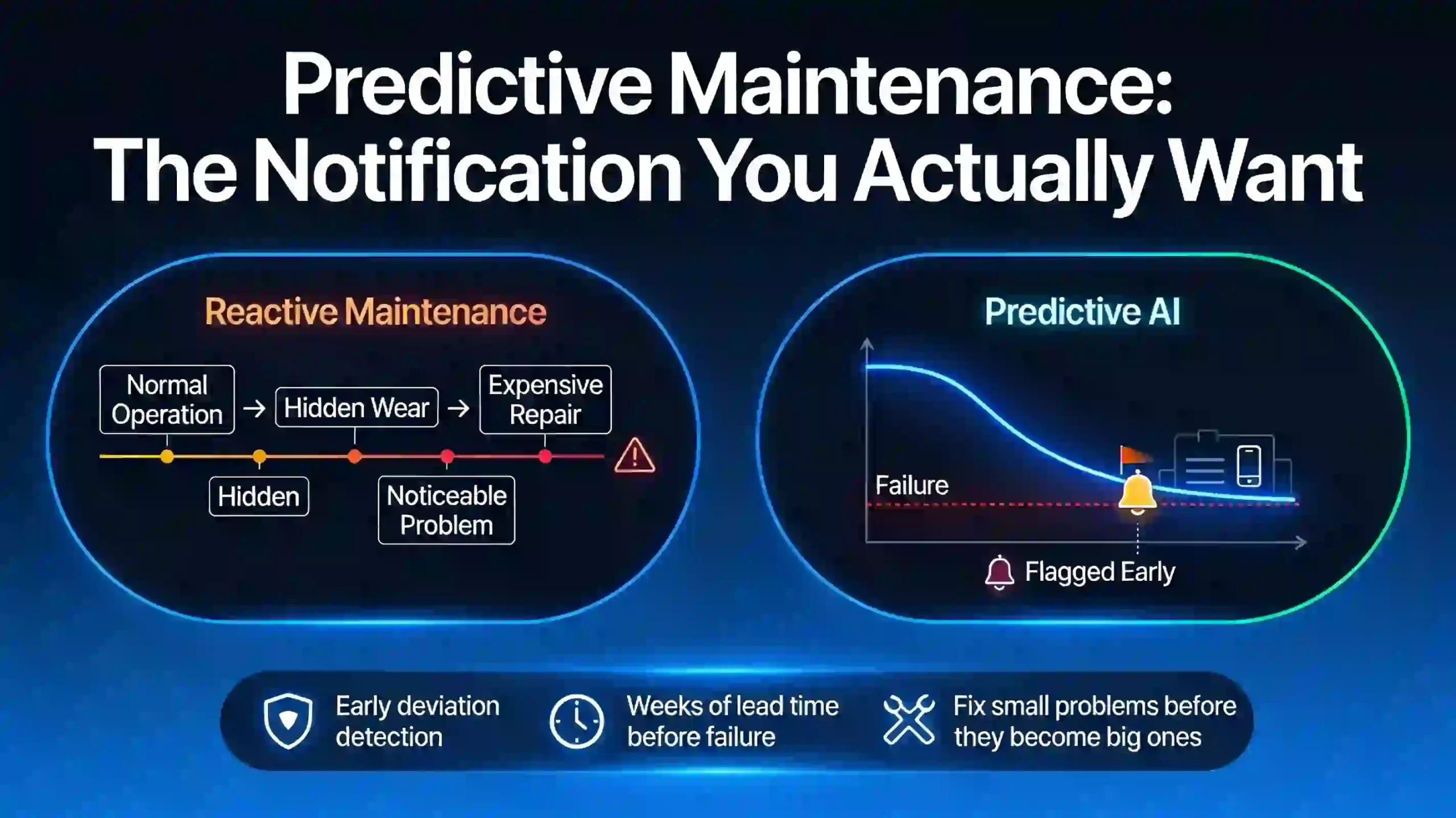
The traditional maintenance experience for any bike, electric or otherwise, is reactive by design. Something fails or degrades enough to become noticeable, and then you deal with it. For mechanical bikes with cheap components, this is inconvenient. For electric bikes where a battery service can cost several hundred dollars, it’s a real problem.
AI-driven predictive maintenance changes the model. The system monitors component behavior continuously, compares it against established baselines, and flags deviations early — before they’re perceptible as performance degradation.
The motor controller tracks its own efficiency as a normal part of operation. When drivetrain wear increases friction, the motor works fractionally harder to maintain output. That inefficiency shows up in the relationship between power input and speed output, and the AI detects the deviation early. Brake response timing is monitored against learned benchmarks. Battery cells are tracked individually across hundreds of charge cycles, with the system building degradation models that can project when capacity will drop below a useful threshold with enough accuracy to give the rider weeks of advance notice rather than a sudden surprise.
✅ Actionable Intelligence
The output arrives as a push notification specific enough to actually be useful. Not “service your bike soon.” Something like: “Rear brake pads estimated 200km remaining based on current wear rate.” That’s actionable information that lets you plan maintenance around your schedule rather than react to failures at inconvenient moments.
For e-bike brands, this technology has implications beyond rider experience. Predictive maintenance data, aggregated across a fleet of connected bikes, reveals failure patterns at scale — which components fail earliest under which conditions, which riding profiles accelerate wear, which firmware versions correlate with better component longevity. That information feeds directly back into product development.
06 Battery Intelligence: Managing Every Watt

The battery is simultaneously the most expensive component on an e-bike and the one that most directly determines the daily ownership experience. Intelligent battery management has become one of the most consequential areas of AI development in the category.
Cell-Level Vs. Ride-Level Management
At the cell level, modern BMS firmware builds individualized models of each battery pack’s behavior from its charge history. Every cycle produces data about how individual cells charge and discharge, how they respond to temperature, how their capacity characteristics evolve over time. The AI uses this data to personalize the charging protocol — adjusting charge rate and cutoff voltage for the specific pack based on its actual measured history rather than applying generic parameters. The result is meaningfully extended battery lifespan compared to static charging protocols, which matters considerably given replacement costs.
At the ride level, AI power management treats the battery’s charge as a budget to be spent intelligently across the entire ride. Systems with GPS integration can analyze the elevation profile of a planned route in advance and distribute energy expenditure accordingly — spending more freely in sections where efficiency is naturally high, conserving in anticipation of sustained climbs, adjusting dynamically when actual conditions diverge from the plan.
Range estimation has improved dramatically as a direct result. Early e-bike range estimates were notoriously unreliable — optimistic figures that assumed flat terrain and gentle riding conditions. AI-driven range calculations account for actual battery state, upcoming terrain from route data, real-time rider effort, ambient temperature, and the specific consumption history of that rider on that bike. The estimates are accurate enough to actually trust, which removes the range anxiety that limited how confidently riders could plan trips on battery-powered bikes.
07 Smart Security: Catching The Theft, Not Just Finding The Bike
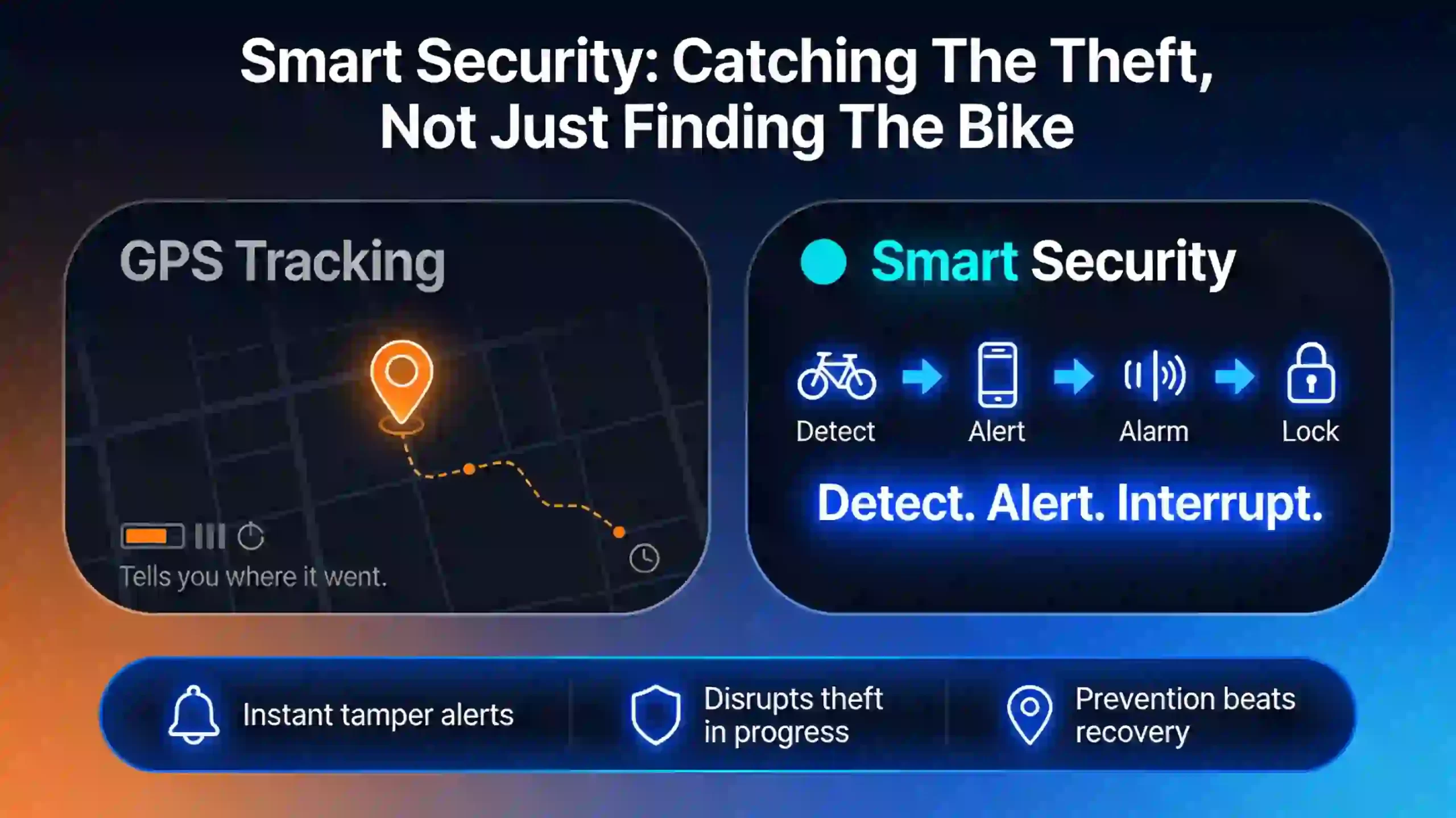
GPS tracking remains the dominant anti-theft approach in the e-bike market, and the frustration with its limitations is widespread among anyone who has actually needed to use it.
Knowing where a stolen bike is and successfully recovering it are not the same thing. GPS tells you where the bike went. It doesn’t stop it from being taken, and for most riders in most situations, acting on a location alone is complicated.
AI-based security approaches this differently. Rather than tracking location after the fact, these systems focus on detecting theft attempts as they happen.
The foundation is accelerometer-based behavioral modeling. The system learns what a parked bike’s sensor signature looks like in normal conditions — the specific vibration patterns of nearby traffic on different road surfaces, the motion profile of pedestrians bumping the bike, the oscillations from wind. This baseline is refined continuously. When sensor data deviates from that baseline in ways consistent with being lifted, tilted sharply, or carried — patterns that are quite distinct from ambient environmental motion — the alert fires immediately.
The timing advantage is significant. The alert fires within seconds of the theft beginning. The bike may not have left the parking spot yet.
Geo-fencing provides a second layer that works even when the accelerometer-based detection might be circumvented — any movement outside a defined zone while the bike is locked triggers an alert regardless of how carefully the bike is moved. Early V2X integration, where bikes broadcast their status to nearby connected infrastructure, begins to appear in 2026 hardware and points toward a future where a stolen bike is visible to the broader network it passes through — not just to its owner’s tracking app.
08 Biometric Integration: When The Bike Reads You

Everything described so far represents AI systems reading the bike’s mechanical state and environmental conditions. The next development layer adds the rider’s physiological state to the picture.
Heart rate integration — adjusting power assistance in real time based on the rider’s actual exertion level rather than just their mechanical inputs — moved from concept to working prototype at CES 2026. The logic is straightforward and the implications are broad. If heart rate climbs above a defined target zone, assist increases to reduce load. If the rider is comfortably below threshold, assist backs off. The bike stops responding to how hard you’re pedaling and starts responding to how hard you’re working.
For fitness riders and health-conscious commuters, this is a categorically different product. For riders with cardiovascular conditions or recovering from injury, it’s a safety layer that fixed assist modes simply cannot provide.
The technical pathway to deployment is established. ANT+ and Bluetooth Low Energy both support heart rate monitor pairing at the firmware level. The integration work is primarily in motor controller firmware and companion app design. Full consumer deployment is expected within 12 to 18 months from manufacturers actively developing this capability.
Solid-state battery development runs on a parallel timeline and will expand what AI power management can do when it arrives. Current systems work within lithium-ion chemistry constraints — thermal sensitivity, charge rate ceilings, cycle degradation. Solid-state packs carry higher energy density, charge faster, degrade more slowly, and behave more consistently across temperatures. The AI’s operating envelope widens considerably. More energy to manage, more stable behavior to model, more room to optimize across a wider range of conditions.
09 What All Of This Means For Riders And Manufacturers
The practical takeaway for riders is that the e-bike purchase decision has gained a new dimension. Hardware specs — motor wattage, battery capacity, frame geometry — remain important. But the software layer now determines a significant part of the riding experience, and evaluating it requires different questions.
- How sophisticated is the manufacturer’s AI system?
- How frequently does the firmware get updated, and do those updates actually improve performance?
- What does the companion app do beyond displaying speed and battery level?
- How does the maintenance prediction system communicate, and how accurate is it in practice?
These weren’t questions that existed in the e-bike buyer’s toolkit three years ago. They’re now as important as asking about motor weight.
For manufacturers, the implication is structural. Building a competitive e-bike in 2026 requires software engineering capability alongside mechanical engineering capability. The firmware team matters as much as the motor design team. The ability to push meaningful OTA updates — and to have the data infrastructure to know what to update and why — is now part of what separates brands that will remain competitive from those that won’t.
The bikes rolling out today are genuinely impressive by any historical standard. The motor intelligence running on current-generation hardware has produced riding experiences that weren’t possible two years ago. And the development pipeline — biometric integration, solid-state battery pairing, V2X connectivity, deeper personalization — suggests that today’s systems will look like early drafts by the end of the decade.
🏁 A Fundamental Shift
The motor is learning. Every ride, every firmware cycle, every data point from every connected bike in the field feeds back into systems that improve what every rider on every connected bike experiences.
That’s not a feature. That’s a fundamental shift in what an electric bike is.