The Hidden Problem Stopping People From Buying E-Bikes: Secure Parking
Most e-bike articles obsess over motors, batteries, torque numbers, and range claims. Fine. Those things matter.
But in dense cities, a colder question decides the purchase before the motor ever spins:
Where do you put the bike?
Not in theory. Not in a glossy product photo. At 10:40 p.m., after work, when the hallway is narrow, the elevator smells like takeout, the battery needs charging, and the bike costs enough money to make theft feel personal.
That is the real urban e-bike problem.
New York City just put a spotlight on it. In May 2026, NYC DOT announced the public planning process for a Secure Bike Parking Program that will build a network of 500 secure bike parking locations across the city1. The city is asking residents where these locations should go, what type of bikes they need to store — standard bikes, e-bikes, cargo bikes, adaptive bikes — and what amenities they want, including e-bike battery charging, tire pumps, and bike repair stations1.
That sounds like infrastructure paperwork.
It is not.
It may be one of the clearest signs that cities are finally understanding what blocks e-bike adoption: not desire, not usefulness, not even price alone. Ownership friction. The daily grind around storage, charging, theft, stairs, building rules, and the ugly little moment when a rider realizes the bike is brilliant outside but impossible inside.
The e-bike industry talks about range. City riders talk about storage.

A commuter can forgive a bike that needs one extra charge per week. They cannot forgive a bike that has nowhere safe to sleep.
NYC DOT said many New Yorkers, especially families, avoid bike ownership because they lack storage space at home, especially for larger family-oriented cargo bikes1. The agency also said secure bike storage is critical because many residents cannot carry heavier e-bikes or cargo bikes up stairs in apartment buildings1.
That one sentence explains more about urban e-bike adoption than a hundred wattage charts.
A regular bicycle can sometimes be dragged up three flights by a tired person with stubborn wrists. A cargo e-bike is different. It is longer. Heavier. More awkward. It does not politely pivot around apartment corners. It scrapes walls, bumps doors, blocks shared hallways, and turns a ten-second parking decision into a physical negotiation with the building.
Then there is theft.
Transportation Alternatives said in the NYC DOT release that lack of secure bike parking is the number two reason New Yorkers choose not to ride a bike, after wanting to feel safer, and that 26% of New York City households have experienced bike theft1. For e-bike buyers, that fear lands harder because the bike is not a $200 beater chained outside a deli. It is transport, work tool, school-run machine, grocery hauler, and sometimes the most expensive object a person owns after their car.
Lose it, and the week caves in.
Secure parking is not a luxury feature. It is ownership infrastructure.
A city can paint bike lanes forever, but if riders cannot store the bike, the purchase stalls.
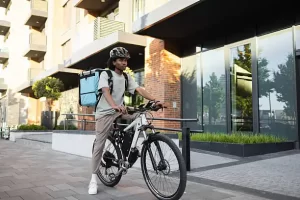
Secure parking solves a different layer of the problem. It touches the before-and-after of every ride: where the bike lives overnight, where it waits during work, whether the battery can be charged safely, whether a parent can store a cargo bike near home, whether a delivery worker can lock up without staring back at the curb every thirty seconds.
NYC DOT’s planned system matters because it treats bike storage as public infrastructure, not a private inconvenience dumped on the rider1. The feedback portal asks residents what type of bicycle they want to store and whether they need long-term, short-term, overnight, or weekend parking1. That distinction is sharp. A rider parking for twenty minutes outside a pharmacy has a different problem from a delivery worker storing a work bike overnight or a parent trying to keep a cargo bike near an apartment.
One rack does not serve all of them.
Cargo e-bikes make the storage problem impossible to ignore
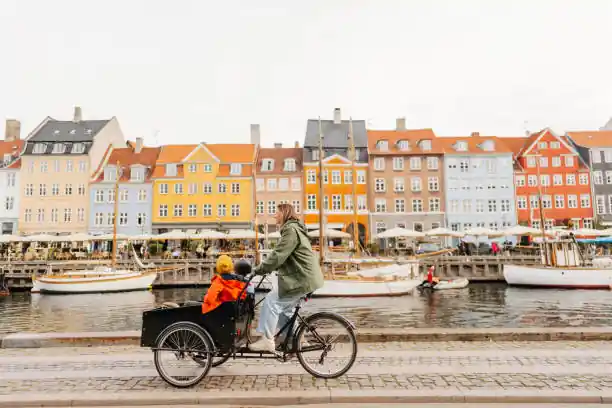
Cargo e-bikes are the most convincing car-replacement bikes. They are also the hardest bikes to park.
That contradiction is the whole fight.
A cargo e-bike can replace school runs, grocery trips, daycare pickups, local errands, and some second-car duties. Research reported by UKRI in 2025 found that e-cargo bikes can substitute many car journeys, including school runs, shopping, and family outings, based on a trial involving 49 households in British suburbs2. Portland’s 2026 e-bike rebate program also treats cargo bikes as serious transportation tools, offering up to $2,350 for cargo e-bikes compared with up to $1,600 for standard e-bikes, plus up to $300 for approved accessories3.
Cities see the use case.
But a family cargo bike is not something you casually slide behind a couch. It may need ground-level access. It may need a wider door. It may need a longer parking bay. It may need weather protection, a charging plan, and enough room that the child seat, rails, panniers, or front box do not become a daily curse.
This is where many “cargo e-bike replaces a second car” arguments fall apart. They talk about the trip. They forget the parking.
The trip may be easy. The bike room may be war.
Delivery workers already know this problem in their bones

NYC’s announcement also names a group that lives with this problem every day: delivery workers.
Ligia Guallpa, Executive Director of Worker’s Justice Project and Co-Founder of Los Deliveristas Unidos, said in the NYC DOT release that for the city’s 80,000 deliveristas, secure bike infrastructure is a core workplace condition, and that without secure parking, workers face constant theft risk and may lose their primary source of income overnight1. She also connected secure storage and safe charging infrastructure to worker safety, public safety, and low-carbon last-mile delivery1.
That is the hard version of the e-bike storage problem.
For a recreational rider, theft is painful. For a delivery worker, theft can erase rent money. The bike is not a weekend toy. It is a wage machine with pedals.
A serious e-bike city has to design for that reality.
Safe charging has become part of the parking conversation
Parking and charging used to be separate topics. In 2026, they are welded together.
NYC DOT’s feedback portal lets residents indicate preferred amenities such as e-bike battery charging at secure parking locations1. That matters because e-bike charging is where convenience, fire anxiety, building rules, and daily logistics collide.
Apartment riders often face a bad set of choices:
- Carry a heavy battery upstairs every night.
- Charge in a cramped apartment.
- Leave the bike outside and risk theft.
- Use informal charging setups that may not be accepted by landlords or building managers.
- Skip buying the bike entirely.
Secure parking with managed charging could cut through that mess. Not every location needs charging, and not every battery should be treated casually. But if cities want e-bikes to become everyday transport, charging cannot remain an improvised ritual behind a couch or under a restaurant counter.
It needs rules. Hardware. Ventilation. Access control. Maintenance.
Boring stuff.
Exactly the stuff that makes transportation systems work.
What good secure e-bike parking should include
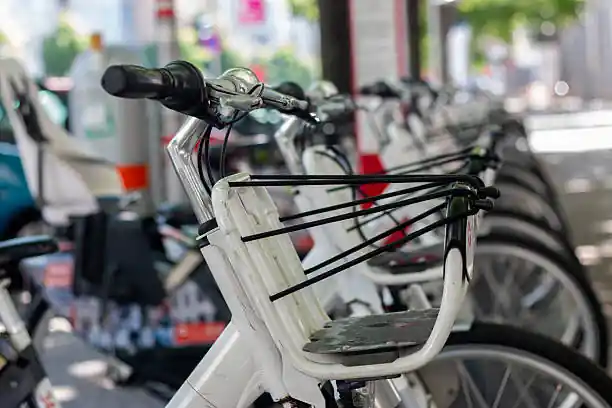
A metal cage alone is not enough.
If cities and private operators want secure e-bike parking to work for real riders, the system needs to handle the dirty details of daily use.
| Feature | Why it matters |
|---|---|
| Ground-level access | Heavy e-bikes and cargo bikes are difficult or impossible for many riders to carry upstairs; NYC DOT identified stair-carrying as a barrier for heavier e-bikes and cargo bikes1. |
| Cargo-bike-sized spaces | NYC DOT’s portal asks users what type of bicycle they want to store, including cargo bikes and adaptive bikes1. These bikes need more room than standard bikes. |
| Locked access | Theft fear blocks ownership; Transportation Alternatives said 26% of NYC households have experienced bike theft1. |
| Long-term and short-term options | NYC DOT’s feedback process asks whether storage is needed for long-term, short-term, overnight, weekends, or other time frames1. |
| Battery charging | NYC DOT lists e-bike battery charging as a preferred amenity residents can request1. |
| Tire pump and repair station | NYC DOT also lists tire pumps and bike repair stations as amenities residents may request1. Small maintenance failures kill daily habits. |
| Affordable memberships | NYC DOT said the program will include discounted memberships for low-income New Yorkers1. Without that, secure parking risks becoming another benefit for people who already have options. |
The best secure parking system will feel unremarkable. You roll in, lock, charge if needed, leave. No drama. No staircase. No prayer.
What e-bike buyers should ask before purchasing
Before buying an e-bike in a dense city, ask these questions with brutal honesty.
1. Can I store it without hating my life?
Measure everything: doorway width, elevator depth, hallway turns, stair access, bike-room space, garage access, and the distance from storage to the street. A bike that technically fits but requires five minutes of wrestling will slowly stop being used.
Friction wins.
2. Can I charge it safely and conveniently?
If the battery is removable, where will you charge it? If it is not removable, where does the whole bike go? Does your building have rules about e-bike batteries? Do you need a certified battery system for peace of mind, insurance, or building compliance?
Do not solve charging after delivery day. Solve it before checkout.
3. What happens when I ride somewhere?
Home storage is only half the problem. Where will the bike sit at work, school, the grocery store, the gym, or a friend’s apartment? A bike that is safe only at home is not transport. It is a nervous hobby.
4. Is theft protection part of the budget?
A lock is not an accessory in urban e-bike ownership. It is part of the drivetrain of your life. Budget for a serious lock, a secondary lock, lights, possible GPS tracking, and insurance review.
Portland’s 2026 rebate program includes locks and lights among approved accessory categories, which is a small but telling detail: public programs know that security and visibility are part of making e-bike ownership work3.
5. If this is a cargo e-bike, where does the extra length go?
Cargo bikes are not just heavier. They occupy awkward space. A long-tail may fit where a front-loader will not. A compact cargo bike may be enough if you carry one child and groceries. A big box bike may be perfect for the school run but miserable in a tight apartment building.
The best cargo e-bike is the one you can actually store.
6. Is there public secure parking nearby?
This is where programs like NYC’s become important. If secure parking exists near home, work, schools, transit hubs, or shopping streets, the buying decision changes. The bike no longer has to solve every storage problem alone.
The city becomes part of the product.
What this means for e-bike brands
E-bike brands should stop treating storage as a footnote.
A buyer who lives in a detached house with a garage buys differently from a buyer in a fourth-floor walk-up. A parent shopping for a cargo e-bike is not only comparing motors. They are imagining the bike at the school gate, outside the grocery store, inside the apartment lobby, plugged in somewhere safe, locked overnight, dry enough to use tomorrow.
Brands that understand this can write better guides, build better product pages, and sell with less fantasy.
Useful content angles include:
- “How to store an e-bike in an apartment.”
- “Can you own a cargo e-bike without a garage?”
- “E-bike theft prevention checklist for city riders.”
- “How to charge an e-bike battery safely at home.”
- “Cargo e-bike storage: long-tail vs. front-loader vs. compact cargo.”
- “What secure bike parking should include for e-bikes.”
That content will catch search traffic because the questions are not imaginary. They come from the exact moment before purchase, when the buyer wants the bike but sees the staircase.
References
[1] NYC DOT — “Bike Month: NYC DOT Invites New Yorkers to Propose Secure Bike Parking Locations, Releases 2026 Bike Map” — https://www.nyc.gov/html/dot/html/pr2026/nyc-dot-invites-new-yorkers-to-propose-secure-bike-parking-locations.shtml
[2] UKRI — “E-cargo bikes can replace car trips and reshape family travel” — https://www.ukri.org/news/e-cargo-bikes-can-replace-car-trips-and-reshape-family-travel/
[3] Portland Rides — Standard/Cargo Applicants — https://portlandebikerebate.com/standard-cargo-applicants/