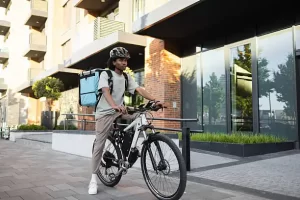

There is no comparison between a bike and an E-Bike.
The power that changes everything. No more arriving sweaty. No more dreading the hill home. No more skipping errands because the car is a hassle.
Whether you are a daily commuter racing against the morning sun, a senior rediscovering the joy of independent movement, or a parent carrying the most precious cargo of all. One thing you must know is that speed comes with a cost. The faster you go, the more you owe it to yourself-and everyone around you-to ride with your eyes wide open.
Quick Notes:
Your Personal Shield – Protection in the Velocity Age
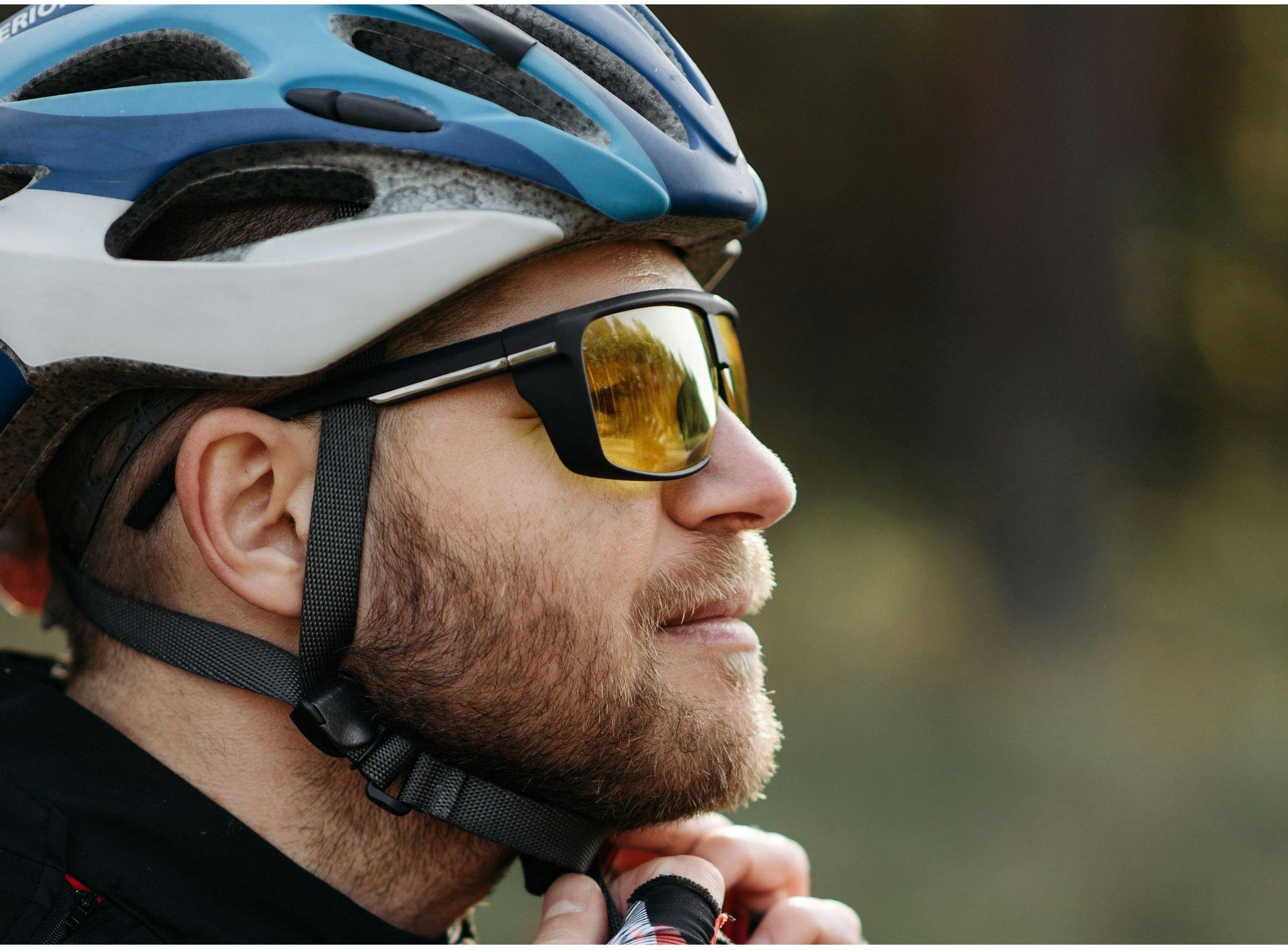
At 25 or 45 km/h, the physics change. The kinetic energy involved in a fall isn’t just a scraped knee anymore-it’s a force that can reshape lives.
In this new reality, your helmet transforms from a legal accessory into a meticulously engineered life-saving system.
The NTA 8776 Standard: Your Certificate of Survival
Forget ordinary bicycle helmets. They were designed for another era. Look for the NTA 8776 certification-it’s not just a label, it’s a promise.
These helmets are engineered specifically for the unique demands of high-speed e-bikes, absorbing a staggering 43% more impact energy than standard helmets.
They wrap their protection around your temples and the back of your skull-the precise territories most vulnerable in e-bike accidents.
The MIPS Factor: Protecting What Matters Most
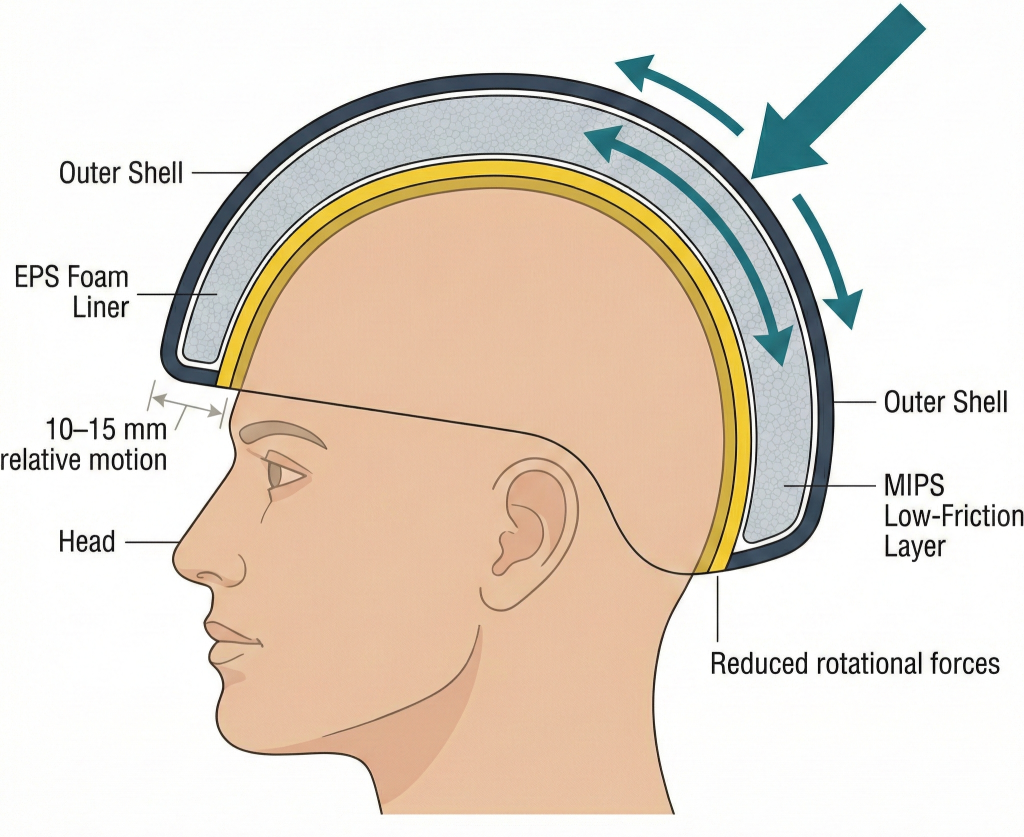
Modern helmets now embrace “Multi-directional Impact Protection Systems.” This isn’t marketing jargon; it’s neuroscience in action.
MIPS technology creates a low-friction layer between the helmet’s outer shell and your head, allowing it to slide slightly upon impact.
This simple sliding motion reduces the rotational forces that cause concussions-the invisible injuries that can alter a life forever. Since most falls happen at an angle, not straight down, this technology isn’t optional; it’s essential.
Beyond the Helmet: Armor for the Modern Rider
Protection is a symphony, not a solo. Your hands, gripping those handlebars for hours, absorb constant vibrations from the motor’s torque.
Padded gloves aren’t comfort-they’re nerve preservation. Kevlar-lined clothing isn’t fashion-it’s your second skin when asphalt tries to peel away the first.
And for those who demand the ultimate, airbag vests now deploy automatically upon detecting a fall, creating a protective cocoon around your spine before you even register what’s happening.
Protecting the Vulnerable – Seniors and Children

The e-bike revolution belongs to humanity in all its beautiful diversity.
But our most precious riders-those at the beginning and sunset of life-need strategies written just for them.
For Seniors (The 65+ Explorers): Freedom Reimagined
For many seniors, e-bikes are nothing short of miraculous. They restore mobility when knees grow tired and hills become mountains.
They reconnect people with their communities, their gardens, their grandkids. But this gift comes with specific considerations.
For Children (The Next Generation): Carrying What Matters Most
If you ride a cargo bike or carry a child seat, you’ve accepted the most beautiful responsibility.
But physics doesn’t compromise for love. That extra weight behind you-those 15 or 20 kilograms of pure preciousness-fundamentally changes your bike’s center of gravity.
The statistic that haunts: Research shows that 30% of child injuries involving e-bikes occur when the bike is completely stationary-during mounting, dismounting, or that brief moment you thought “it’ll be fine, I’m right here.”
Mechanical Mastery – Power Demands Balance
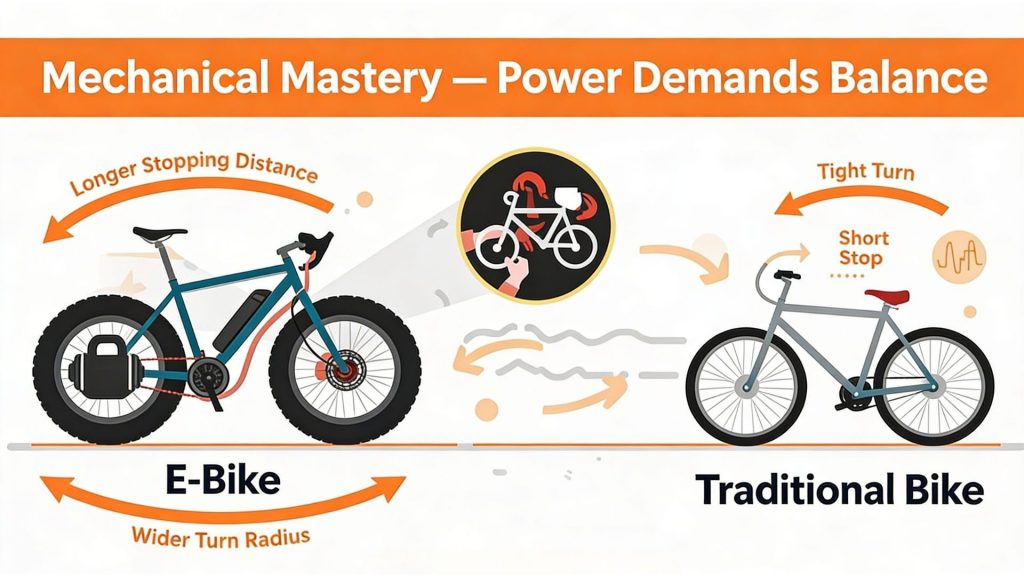
An e-bike carries weight. Between 20 and 30 kilograms more than its acoustic cousin (as purists call traditional bikes).
This extra mass is your ally on hills but your adversary in emergencies. It demands more distance to stop, more space to turn, more respect to control.
The Hidden Danger of Mass: What Weight Really Means
Those 20-30 extra kilograms aren’t just felt when you lift the bike-they’re felt in every interaction with the road. This weight multiplies the forces acting on your tires, your rims, your spokes. And nowhere is this more critical than in tire pressure.
Here’s the physics they don’t teach you at the bike shop: A heavy e-bike running on slightly soft tires creates immense flexing in the sidewalls with every revolution. This flex generates heat.
This heat weakens the structure. And when you hit a pothole or curb at 40 km/h with under-inflated tires, you’re not just risking a flat tire-you’re risking a “pinch flat” that can instantaneously dump all air from your tire. At speed, this isn’t an inconvenience. It’s a catastrophe. The rim strikes the pavement, the steering becomes instantly unpredictable, and control vanishes before you can process what’s happened.
ABS: Not Just for Cars Anymore
In 2026, premium e-bikes arrive equipped with Anti-lock Braking Systems. This isn’t automotive technology trickling down-it’s life-saving engineering recognizing that two wheels need the same intelligence as four.
ABS prevents your front wheel from locking up on wet pavement, loose gravel, or sandy corners. It pulses those brakes faster than human reflexes can, maintaining steering control when instinct screams “squeeze harder!” Studies estimate this single technology reduces skidding accidents by approximately 25%.
Hydraulic brakes have also become standard on serious e-bikes. They offer modulation that cable systems cannot match-the difference between stopping precisely and stopping suddenly.
Smart Diagnostics: When Your Bike Talks, Listen
Your e-bike now communicates. Through apps, through displays, through gentle vibrations. When you receive a notification about “Brake Pad Wear” or “Chain Tension Alert,” your bike isn’t being dramatic-it’s being honest.
A mechanical failure at 40 km/h isn’t an inconvenience. It’s a crisis. That chain snap that would have made you wobble at 15 km/h becomes a catapult at higher speeds.
Those worn brake pads that would still “kind of work” around the neighborhood become spectators at an intersection you cannot stop for. On bikes without smart diagnostics, the burden shifts entirely to you. Your ears must detect the subtle grinding of failing bearings.
Your eyes must catch the uneven wear pattern on brake pads. Your hands must feel the slight play in headset or suspension. You become the sensor-and you must be vigilant.
Remember: Control isn’t just your skill-it’s the result of an entire mechanical system operating at peak integrity.
Battery Respect – The Energy That Powers Can Also Consume
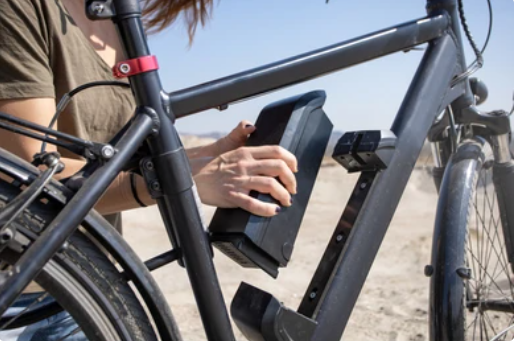
The lithium-ion battery is your e-bike’s heart. It’s also a sophisticated chemical reactor containing enough stored energy to power your home for a day.
This duality-liberator and potential destroyer-demands a relationship built on knowledge and reverence.
UL 2849: The Gold Standard Worn Invisible
When you choose an e-bike, look for UL 2849 certification. This isn’t marketing-it’s the result of rigorous testing that ensures your battery, motor, and charger work together in harmony.
It’s the peace of mind that engineers have pushed this system to its limits so you never have to.
The Battery Management System (BMS): The Guardian Within
Inside every quality battery lurks an unsung hero: the Battery Management System. This tiny circuit board constantly monitors temperature, voltage, and current.
It’s the first line of defense against “thermal runaway”-that terrifying chain reaction where one overheating cell triggers its neighbors in a cascade of chemical fire.
The BMS never sleeps. It balances cells, cuts power when things get too hot, and generally acts as the responsible adult in the room while you enjoy your ride.
The Sacred Rules of Charging:
Use only the original charger. Statistics show that 60% of battery fires trace back to uncertified, third-party charging equipment. That $20 “compatible” charger from an online marketplace isn’t a bargain-it’s a gamble with your home.
Charge in a ventilated space. Not in your bedroom while you sleep. Not blocking your only exit. A kitchen counter or garage, where fresh air circulates and escape routes remain clear.
Replace when efficiency drops. When your range diminishes noticeably, when charging takes longer, when the battery feels hot to the touch-these aren’t inconveniences. They’re messages. Listen.
If You See Smoke or Smell Something Sweet:
That unusual odor-almost like overripe fruit mixed with chemicals-is your final warning. If you see smoke or smell that distinctive sweet warning:
- Move away immediately. Not casually-urgently.
- Call emergency services. This is not a DIY situation.
- Never use water. Lithium fires have their own chemistry. Water can actually make them worse, spreading burning particles. Special Class D extinguishers or simply letting professionals handle it is the only safe approach.
The Full Circle: Battery Afterlife and Sustainability
A truly conscious rider thinks beyond the moment. They consider not just how to use the battery safely, but what happens when its useful life ends.
In 2026, the most forward-thinking manufacturers offer “second life” programs-retired e-bike batteries finding new purpose as home energy storage, smoothing out solar power fluctuations or providing backup during outages. Others ensure responsible recycling, recovering precious metals and keeping toxic materials from landfills.
When your battery finally loses its range, don’t abandon it in a drawer or-worse-general waste. Seek out certified recyclers.
Ask your manufacturer about take-back programs. The same respect you showed the battery during its life should extend to its death. The guardian mindset doesn’t stop at your own safety; it extends to the planet that hosts your journey.
Digital Security – Your Bike Is Now a Computer
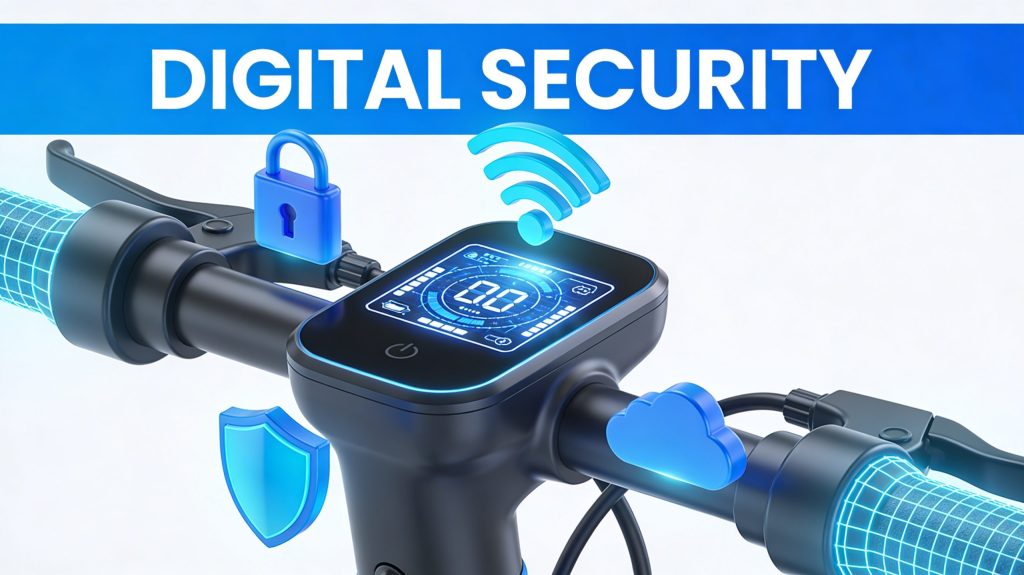
In 2026, your e-bike exists in two worlds simultaneously: the physical realm of roads and trails, and the digital realm of data and connectivity.
It’s part of the Internet of Things (IoT), which means it shares both the benefits and vulnerabilities of any connected device.
OTA Updates: Your Digital Armor
When your bike requests an “Over-the-Air” software update, it’s not just seeking new features or a refreshed interface.
These updates often contain critical security patches for your Battery Management System, your motor controller, your connectivity modules. They close doors that hackers might otherwise open.
Installing updates isn’t optional anymore-it’s as essential as tightening your bolts.
The Speed Hack Warning: Temptation That Costs Everything
We understand the temptation. That software limiter keeping you at 25 km/h when the motor clearly has more to give. The online forums promising “easy unlocks” and “full potential revealed.” But here’s what those forum posts don’t tell you:
Removing the speed limiter-whether through software “tuning” or hardware modifications-doesn’t just make you faster. It:
- Places fatal stress on a frame never designed for those speeds
- Overheats motors running beyond their duty cycle
- Overloads brakes never tested at those kinetic energies
- In most jurisdictions, immediately voids your insurance and strips your legal protection
If you crash at 50 km/h on a bike designed for 25, you’re not an unfortunate victim. In the eyes of the law, you’re someone who knowingly created an unsafe vehicle. Your insurance won’t pay. Your warranty won’t cover. Your medical bills become yours alone.
This warning is doubly urgent for budget e-bikes. Their simpler controllers and less sophisticated firmware make them remarkably easy to “tune.”
A few minutes with a YouTube tutorial, and suddenly that 25 km/h commuter becomes a 45 km/h “machine.” But the frame wasn’t tested at those speeds. The brakes weren’t specified for that kinetic energy.
The tires weren’t rated for that heat buildup. The rider has created a vehicle that looks like a bicycle but behaves like a motorcycle-with none of the engineering safety margins a real motorcycle would have.
Guard Your Digital Footprint
Your bike knows where you’ve been. GPS data flows to apps, to manufacturers, to cloud services. This convenience is wonderful until it isn’t.
Protect your location data with the same care you protect your banking information. Use strong passwords. Enable two-factor authentication.
Remember that your bike is now an extension of your digital self.
Social Intelligence – The Silent Presence

Here’s an irony of the e-bike revolution: the very silence that makes riding through cities so peaceful also makes you nearly invisible to the human ear.
Pedestrians step into bike lanes without looking because they don’t hear anything coming. Children chase balls into streets.
Seniors cross with deliberate slowness, trusting their hearing to warn them. They cannot hear you.
The Principle of Predictable Riding
Don’t weave through traffic like a motorcycle courier on a deadline. Don’t appear suddenly between parked cars.
Because you travel faster than traditional cyclists, drivers consistently underestimate how quickly you’ll reach intersections. Their miscalculation becomes your danger.
Choose a line. Hold it. Make your intentions obvious through hand signals and consistent positioning.
The Left-Hook Trap: Invisibility at Intersections
Here is the most common scenario for serious e-bike collisions: you’re approaching an intersection. A car approaching from the opposite direction begins to turn left (or right, depending on your side of the road) directly across your path. The driver looks, sees you, and calculates: “That cyclist is far enough away. I have time.”
But the driver’s brain is calibrated for traditional cyclists traveling at 15-20 km/h. They have no framework for your 30-40 km/h closing speed.
By the time they realize their error, you’re already in the intersection, and braking distances that would have been adequate at lower speeds now fail you entirely.
AVAS: Your Acoustic Presence
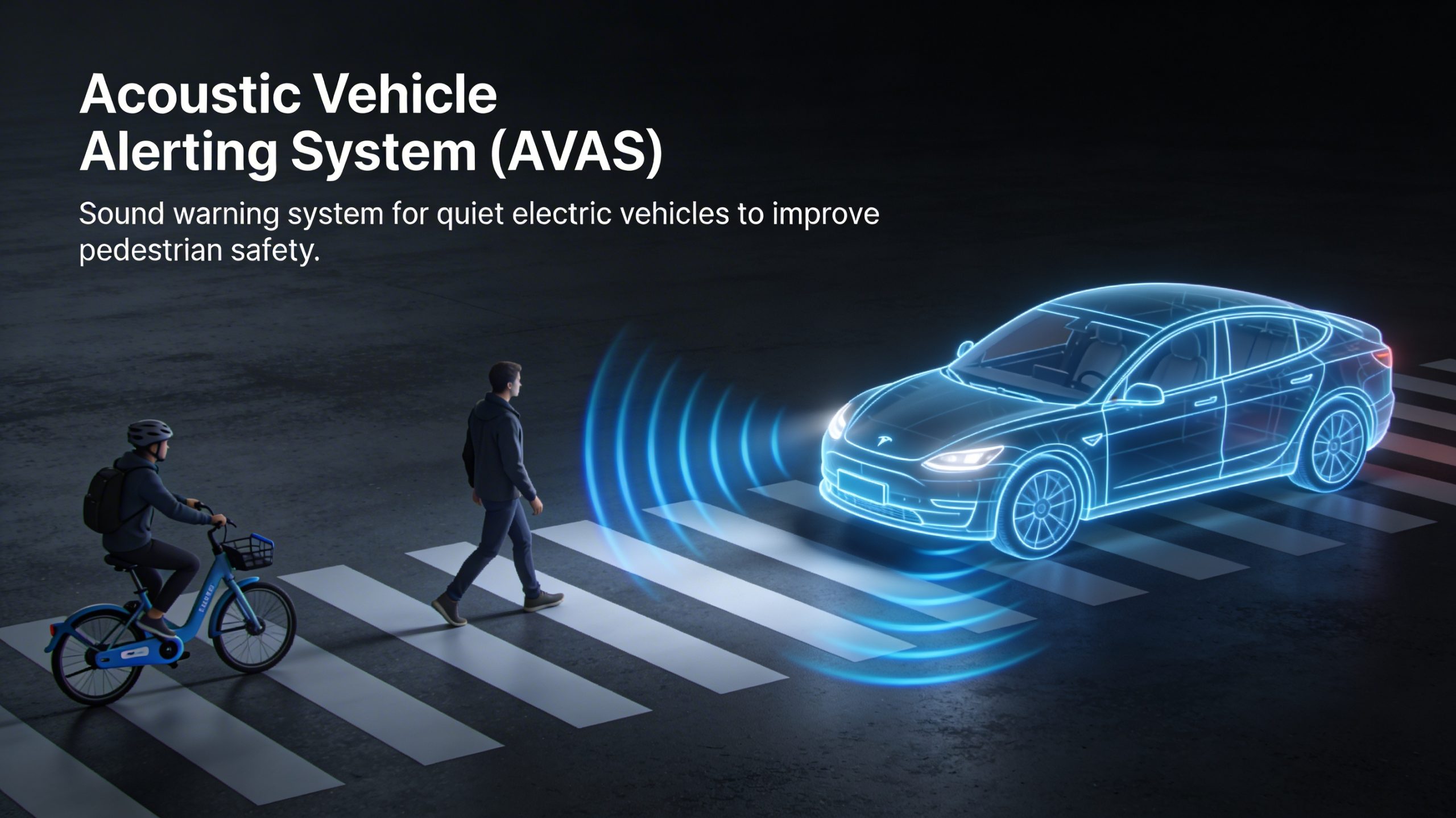
Many 2026 e-bikes now feature Acoustic Vehicle Alerting Systems-deliberate, low-volume sounds that announce your presence without annoying everyone within blocks. If your bike has this feature, use it in crowded areas. If it doesn’t, become your own AVAS. A bell isn’t just polite-it’s preventive medicine. A friendly “on your left” isn’t just courtesy-it’s collision avoidance.
Know Your Legal Category
Different e-bikes inhabit different legal universes:
City E-Bikes: Assistance up to 25 km/h. Generally treated as bicycles.
Speed Pedelecs (S-Pedelec): Assistance up to 45 km/h. Often requiring licenses, insurance, registration, and specific helmets.
Riding a speed pedelec without understanding its legal requirements isn’t just illegal-it’s dangerous in ways you cannot anticipate until it’s too late.
The philosophy of safe riding: Assume everyone else will make mistakes. The pedestrian will step out. The driver will turn without signaling. The child will chase the ball. Your safety lies not in your rights, but in your anticipation.
Maintenance and Emergencies – Preparation Changes Everything
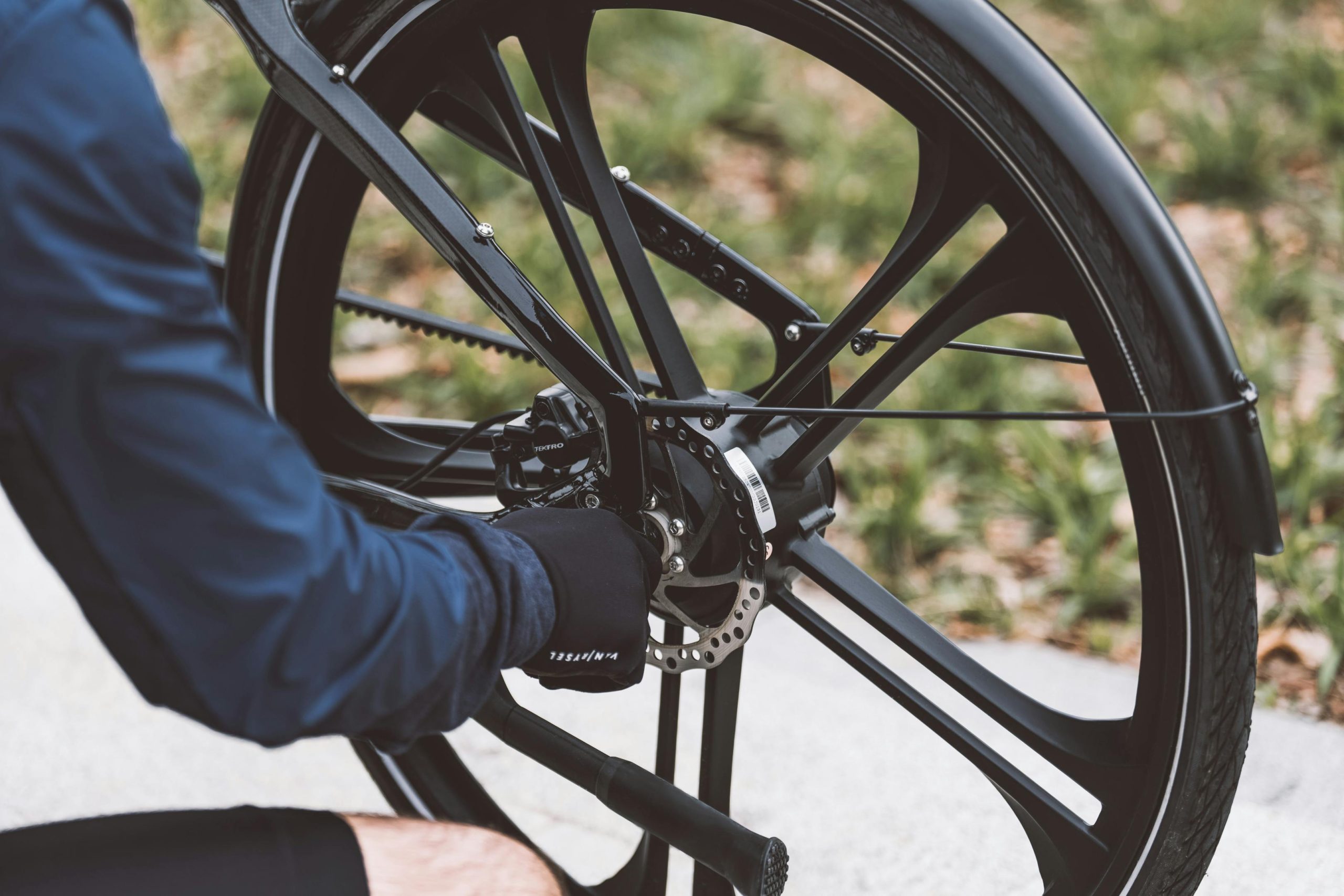
Regular maintenance isn’t about performance-it’s about prevention. It’s the difference between catching a problem in your workshop and discovering it at 40 km/h.
The Periodic Inspection Checklist
Brake Pads and Fluid: Thickness matters. So does contamination. If your pads are glazed or your fluid is dark, address it now.
Frame Integrity: Look for cracks, especially around motor mounts and rear dropouts. The forces an e-bike generates can fatigue metal in ways traditional bikes never do.
Tire Pressure and Tread: Under-inflated tires heat up. Over-inflated tires lose grip. Worn tread loses water displacement. Find the sweet spot and maintain it. Remember: at e-bike speeds and weights, a sudden tire failure is not a wobble-it’s a crash.
Battery Health: Swollen casing? Unusual heat during charging? Dramatically reduced range? These aren’t annoyances-they’re warnings.
In Case of Accident
The golden rule of e-bike first aid: Do not move an injured rider if there’s any possibility of spinal injury. The e-bike helmet that protected their head may have done its job perfectly-don’t undo that protection by moving them incorrectly.
Wait for professionals. They have the training, the equipment, and the experience.
Preparation-a small first aid kit, charged phone, emergency contacts programmed-transforms a potential catastrophe into a manageable incident.
The Unspoken Reality – When Your Bike Isn’t “Smart”
A necessary acknowledgment for millions of riders.
Not all e-bikes in 2026 will be smart. Not all will be connected to the internet, whisper warnings to your phone, or diagnose their own illnesses. The budget e-bike-the workhorse of millions, the affordable freedom machine-exists in a different universe entirely.
This reality opens a wide door onto what we might call “the digital divide in mobility.” And it reveals something essential about safety in our time: Technology doesn’t always protect you. And in its absence, your awareness becomes your first and last line of defense.
When the Bike Doesn’t Warn You, You Must Become the Sensor
In the smart e-bikes our guide primarily describes, the machine watches over itself. Sensors monitor brake pad thickness. Algorithms track battery temperature. The system sends notifications.
The rider is informed. The rider is warned. The rider acts.
But on a budget e-bike-no connectivity, no diagnostics, no digital guardian angel-you must become the sensor. Your ears must detect the subtle grinding that means bearings are failing. Your nose must catch the faint burning smell that precedes electrical trouble. Your body must feel the wobble that signals a loose headset or low tire pressure.
This makes the “Maintenance” chapter infinitely more critical for budget riders. Without smart systems, there is no middle ground between “everything seems fine” and catastrophic failure. The warning signs are there, but they speak in whispers, not notifications.
The truth: On a smart bike, you’re a manager. On a budget bike, you’re a mechanic. Both can be safe, but the second requires more of you.
The Safety Gap: When Physics Doesn’t Care About Your Budget
Our guide speaks of NTA 8776 helmets, ABS braking systems, airbag vests, and hydraulic brakes. These are not luxuries-they are engineering responses to the physical reality of traveling at 45 km/h on two wheels.
But they cost money. Sometimes a lot of money.
Herein lies an uncomfortable truth: The economic class of riders may find themselves piloting heavy, fast machines protected by primitive safety equipment. A standard bicycle helmet, tested at 15 km/h, now facing 45 km/h impacts. Mechanical brakes, designed for 20 kg bicycles, now stopping 35 kg e-bikes. Basic frames, never engineered for sustained motor torque, now flexing under forces they were never meant to handle.
This isn’t about judgment. It’s about physics. And physics doesn’t care about your budget.
The safety gap between what riders can afford and what high-speed travel demands is one of the most pressing-and least discussed-issues in the e-bike revolution.
A Final Thought: Awareness Is Universal
None of this diminishes the value of our guide. If anything, it reinforces why every rider-regardless of their bike’s price tag-needs to internalize its principles.
The smart rider on a basic bike, who checks their brakes weekly, who feels the subtle changes in their machine, who respects the battery’s power, who rides predictably and watches out for others-this rider may be safer than the wealthy owner of a smart bike who assumes technology will save them.
Technology is a tool, not a guardian angel.
In 2026, some bikes will talk to you. Some will remain silent. But every bike, smart or simple, expensive or economical, obeys the same physics and carries the same responsibility.
The Final Wisdom: Technology Grants Power, Awareness Grants Survival

The electric bike stands among the greatest urban innovations of our time. It offers the speed of a car with the intimacy of a bicycle, the efficiency of a machine with the joy of human propulsion. It flattens hills, extends ranges, and opens possibilities that previous generations could only imagine.
But this power, like all power, demands a partner worthy of it.
When you understand this system and commit to it, your e-bike transforms from a potential hazard into one of the safest, most liberating tools of personal mobility ever created.
Remember: You protect your head, you respect your battery, you check your tires, you watch for the grandmother crossing slowly and the child who might run, you ride as if unseen-and in doing so, you become more than a rider. You become a conscious navigator of the future.
Whether your bike whispers warnings to your phone or simply waits for you to notice, whether it cost a fortune or a month’s wages-your awareness, your respect for the machine, and your care for those around you remain the most important safety systems ever invented.