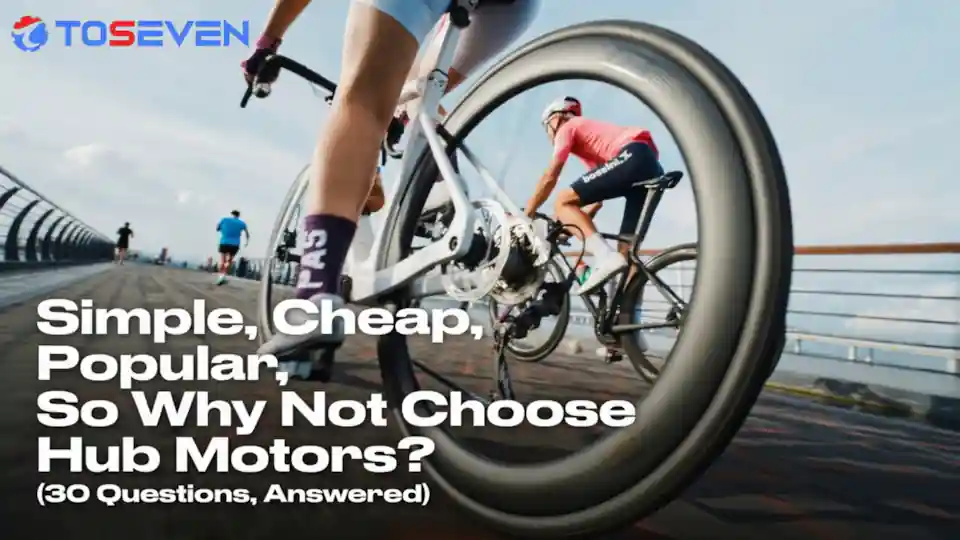
Hub motors power millions of e-bikes worldwide — and for good reason. They are reliable, affordable, low-maintenance, and get the job done for the vast majority of everyday riders. But like any technology, they have real strengths and real limitations that are worth understanding before you buy. These 30 questions cut through the noise and give you straight answers.
1. What is a hub motor?
A hub motor is an electric motor built directly into the center of a bicycle wheel — either the front or the rear. When powered, it spins the wheel from the inside, propelling the bike forward without any connection to the pedals, chain, or gears. It is the simplest and most common type of e-bike motor in the world.
2. How does a hub motor actually move the bike?
The motor sits inside the wheel’s hub and contains a ring of electromagnets. When electricity flows from the battery, those magnets push against each other in a controlled sequence, rotating the hub — and the wheel attached to it — in one continuous motion. The rest of the bike, including the pedals and chain, is completely separate from this process.
3. What is the difference between a front hub motor and a rear hub motor?
A front hub motor drives the front wheel and is the simplest to install — it works independently of the rear drivetrain entirely. A rear hub motor drives the rear wheel, which feels more natural since that is how a regular bike is propelled. Rear hub motors are more common on quality e-bikes because front-wheel drive can feel disconnected and cause traction issues on loose or wet surfaces.
4. Which is better — front hub or rear hub?
Rear hub motors are better for almost every riding situation. Driving the rear wheel feels natural, maintains better traction on hills and wet roads, and keeps weight distribution more balanced. Front hub motors are mainly used in very budget-friendly builds or simple conversion kits where ease of installation matters more than ride quality.
5. What is the difference between a hub motor and a mid-drive motor?
A hub motor sits inside the wheel and drives it directly — it is simple, affordable, and independent of the bike’s gears. A mid-drive motor sits at the pedal axle and drives the chain, using the bike’s gears to multiply its force. Hub motors excel on flat terrain and in low-maintenance urban use; mid-drive motors outperform them on hills, long distances, and anything requiring real efficiency under load.
6. Who is a hub motor best for?

A hub motor is the best choice for riders who commute on mostly flat roads, want a low-maintenance system, and are working with a tighter budget. It is also ideal for casual riders who do not need the natural feel or hill-climbing efficiency of a mid-drive — just reliable, straightforward electric assistance from A to B.
7. What are the two types of hub motors?
Hub motors come in two designs: geared hub motors and direct drive hub motors. A geared hub motor uses internal planetary gears to spin the motor faster than the wheel, delivering high torque in a compact and lightweight package. A direct drive hub motor has no internal gears — the motor spins at exactly the same speed as the wheel, making it simpler but larger and heavier.
8. What is a geared hub motor, and what are its advantages?
A geared hub motor uses a set of internal planetary gears between the motor and the wheel axle. This allows the motor to spin at a higher, more efficient speed while the gears step that down to wheel speed. The result is a lighter, more compact motor that delivers strong torque, runs efficiently at low speeds, and uses a one-way clutch to eliminate drag when the motor is off. It is the most practical hub motor design for everyday riders.
9. What is a direct drive hub motor, and when does it make sense?
A direct drive motor has no internal gears — the motor rotor is the wheel hub itself, spinning at exactly wheel speed. This makes it mechanically very simple with almost no internal wear. The trade-off is significant size and weight. Its main unique advantage is regenerative braking — the ability to recover energy back into the battery when slowing down. It is best suited for flat, long-distance riders who value simplicity and want regenerative capability.
10. What is regenerative braking, and do all hub motors support it?
Regenerative braking is the ability to convert the bike’s kinetic energy back into electricity when decelerating, feeding it back into the battery. Only direct drive hub motors support regenerative braking — geared hub motors cannot do this because their one-way clutch physically disconnects the motor from the wheel when unpowered. In practice, regenerative braking on e-bikes recovers only a small percentage of energy — typically 5–10% — so it extends range slightly but is not a major factor for most riders.
11. Does a hub motor use the bike’s gears?
No — and this is its most significant limitation. A hub motor drives the wheel at a fixed ratio regardless of what gear the rider selects. The gears still affect how hard you pedal, but the motor itself cannot benefit from them. This is why hub motors lose efficiency on steep hills — they cannot shift down to maintain their power band the way a mid-drive motor can.
12. Why does a hub motor struggle on steep hills?

Because it operates at a fixed mechanical ratio to the wheel. On a steep climb, the motor needs to produce maximum torque while the wheel turns slowly — an inefficient operating condition that generates heat and drains the battery quickly. A mid-drive motor bypasses this entirely by using a lower gear, keeping itself in an efficient RPM range regardless of gradient. For flat terrain, this limitation is irrelevant.
13. Does a hub motor make the bike feel natural to ride?
It depends on the quality of the system. A well-tuned rear hub motor with a good torque sensor can feel fairly natural on flat ground. However, because the motor is not connected to the pedals, the assistance does not perfectly mirror your effort the way a mid-drive does — especially during acceleration, gear changes, or sudden bursts of effort. Most riders adapt quickly, but it will never feel as seamlessly integrated as a mid-drive.
14. Does a hub motor add noticeable drag when turned off?
A geared hub motor does not — it uses a one-way clutch bearing that physically disconnects the motor internals when unpowered, so you feel no resistance from the motor itself. A direct drive motor does create magnetic drag when unpowered, which is noticeable when pedaling without assistance, especially on hills. This is one of the practical advantages geared hub motors have over direct drive systems for most riders.
15. How much does a hub motor weigh?
A typical geared hub motor weighs between 2.5 kg and 4 kg. Direct drive motors are heavier — usually 4 kg to 7 kg — due to the larger rotor required to generate sufficient torque without gearing. Because all of this weight sits inside the wheel rather than at the frame center, it does affect handling more noticeably than the same weight added at the bottom bracket by a mid-drive.
16. Does wheel-mounted weight affect how the bike handles?
Yes — and it is one of the more underappreciated differences between hub and mid-drive systems. Weight inside the wheel is called unsprung mass — it increases the rotational inertia of the wheel, making the bike feel slightly heavier to steer, slower to accelerate from a standstill, and less nimble on turns. For casual urban riding this is barely noticeable, but on technical terrain or at higher speeds it becomes more apparent.
17. Are hub motors waterproof?

Most quality hub motors carry an IP65 rating — fully protected against rain and water spray from any direction. This covers everyday commuting in wet weather without any concern. Like all e-bike components, hub motors should never be pressure-washed, as high-pressure water forces past seals regardless of IP rating. IP67-rated motors can also handle brief accidental submersion in shallow water.
18. How long does a hub motor last?
A well-built geared hub motor is designed for 10,000–20,000 km or more with normal use. The internal planetary gears are the only moving parts subject to wear — and in quality motors, these are built to last many years without service. Direct drive motors last even longer mechanically since they have no internal gears to wear out. The motor’s lifespan in both cases typically exceeds that of the battery.
19. Does a hub motor require much maintenance?
Very little — which is one of its biggest practical advantages. The motor unit is sealed from the factory and requires no regular servicing under normal use. Unlike a mid-drive motor, it does not interact with the chain or cassette, so it adds no extra wear to those components either. The drivetrain on a hub-motor e-bike wears at roughly the same rate as a regular bicycle.
20. What happens if the hub motor fails while riding?
The bike continues to function as a normal bicycle. The motor simply stops providing assistance, but the wheel still rolls freely. On a geared hub motor, the one-way clutch ensures there is no resistance from the motor when it is not running. You can pedal home without any mechanical obstruction — you will just be doing it entirely under your own power.
21. Can I repair a hub motor myself?
Basic repairs — such as fixing a flat tire on the motor wheel — require removing the motor wheel, which takes slightly more effort than a standard wheel due to the wiring connector. Internal motor repairs are not recommended for most users, as the motor is a sealed precision unit. If the motor itself fails, replacement of the entire unit is the most practical solution in most cases.
22. Is changing a flat tire harder with a hub motor?
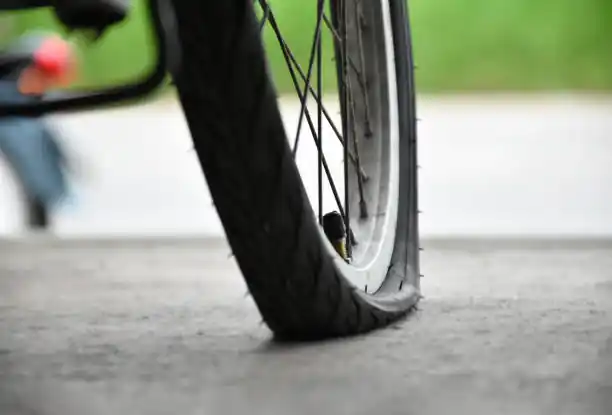
Yes — slightly. Removing a hub motor wheel requires disconnecting the motor cable before the wheel can come off, and the added weight of the motor makes handling the wheel less convenient. It is not difficult, but it takes longer than on a standard bicycle or a mid-drive e-bike. Rear hub motor wheels are heavier and slightly more involved than front hub wheels for this reason.
23. What sensors does a hub motor system use?
Most hub motor systems use a cadence sensor — a simple magnet on the crank that detects whether the pedals are rotating and switches the motor on or off accordingly. Higher quality hub motor systems include a torque sensor, which measures how hard you are pushing and delivers proportional assistance for a more natural feel. A speed sensor is also standard, signaling the motor to cut assistance at the legal speed limit.
24. What is the difference between a cadence-controlled and torque-controlled hub motor?
A cadence-controlled hub motor switches on when the pedals rotate and delivers a fixed power level — simple, consistent, but mechanical in feel. A torque-controlled hub motor measures how hard you push and varies its output proportionally — smoother, more intuitive, and more efficient. The gap in ride quality between the two is significant, and torque sensing is worth paying for even in a hub motor system.
25. How much torque does a hub motor produce?
Most geared hub motors produce between 40 Nm and 70 Nm of torque. Direct drive motors typically produce between 30 Nm and 60 Nm. Both figures are lower than premium mid-drive motors, which regularly exceed 85–120 Nm. For flat urban riding, hub motor torque is more than sufficient — the limitation only becomes apparent on sustained climbs or under heavy load.
26. What wattage do hub motors typically run at?
Most legal hub motors are rated at 250W nominal for EU compliance. In the US market, 500W and 750W hub motors are common. Peak wattage can be significantly higher — a 250W nominal motor may peak at 500W during hard acceleration. For everyday urban use, 250W nominal is sufficient. Wattage alone is a poor indicator of real performance — torque (Nm) and motor quality are more meaningful numbers.
27. Can I convert my regular bike to a hub motor?
Yes — and hub motor conversion kits are among the simplest and most affordable ways to electrify a regular bicycle. A front hub kit requires almost no mechanical knowledge — the motor wheel replaces the existing front wheel, and the battery and display attach to the frame. Rear hub kits take slightly more work but deliver better ride quality. Most standard bikes are compatible with hub motor conversion kits.
28. How much does a hub motor e-bike cost compared to a mid-drive?

Hub motor e-bikes are significantly more affordable. A reliable hub motor e-bike starts at around $800–$1,200. Mid-drive systems start at $1,500 and typically range from $2,000–$4,000 for quality builds. The price gap reflects the engineering complexity of a mid-drive system — for riders who do not need hill-climbing performance, a hub motor delivers excellent value.
29. Is a hub motor e-bike legal in Europe?
Yes — as long as the motor is rated at 250W nominal and cuts assistance at 25 km/h, it is legally classified as a bicycle (pedelec) in the EU. No license, registration, or insurance is required. The same rules that apply to mid-drive e-bikes apply equally to hub motor e-bikes — the legal classification is based on power output and speed limit, not motor placement.
30. Hub motor or mid-drive — how do I decide?
Ask yourself one question: where do you ride? If your routes are mostly flat, your commute is urban, and low maintenance matters — a hub motor is the right and honest answer. If you ride hills regularly, carry loads, want a ride that feels like a real bicycle, or need maximum range — a mid-drive is worth every extra penny. Both are excellent systems built for different jobs. The mistake is not choosing one over the other — it is choosing the wrong one for your terrain.