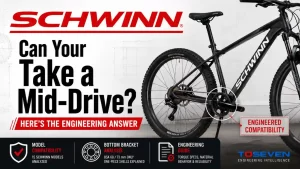

Welcome to the definitive engineering reference for electrifying the Raleigh Pioneer family of bicycles. The Raleigh Pioneer is engineered around a single, unifying mission — long-distance comfort, daily commuter reliability, and utility-grade transport across mixed surfaces. Across every Pioneer generation, this design philosophy has expressed itself through a remarkably consistent mechanical signature: a steel or aluminum trekking-hybrid frame, a BSA 68mm threaded bottom bracket, a fender-and-rack-compatible rear triangle, and a relaxed, upright touring geometry.
That mechanical conservatism makes the Pioneer one of the most predictable and structurally forgiving conversion platforms in the entire mid-drive aftermarket — but it also introduces a specific set of trekking-frame failure modes that must be engineered around with the same rigor applied to a carbon racing platform. Before you order a single TOSEVEN component, you must identify your exact Pioneer generation, verify the bottom bracket shell width and thread condition, and understand how rack-mounted load, fender struts, internal cable routing, and IGH-compatible drivetrains influence the motor mounting interface. The success of the entire build depends on it.
- Raleigh Pioneer Compatibility Overview
- Platform Engineering Analysis — The Pioneer Trekking-Hybrid DNA
- Generation-by-Generation Compatibility Matrix
- Bottom Bracket Engineering — BSA 68mm Threaded Conversion Mechanics
- Chainline, Drivetrain, and Clearance Engineering
- Frame Materials, Fatigue, and Structural Engineering
- TOSEVEN DM01 / DM02 Integration Engineering
- Commuting, Touring, and Daily Reliability Engineering
- Maintenance Engineering and Lifecycle Management
- Mistakes That Can Destroy Your Pioneer Build
- FAQ & Troubleshooting
- Cross-Reference Library
1. Raleigh Pioneer Compatibility Overview
The Raleigh Pioneer lineup spans more than two decades of trekking-hybrid production, with frame variants encompassing 4130 cromoly steel, 6061-T6 aluminum, and aluminum/steel hybrid constructions. Across the Pioneer trekking-hybrid models covered in this guide, three structural traits dominate the conversion picture: modern frames generally use a BSA 68mm threaded bottom bracket, hub spacing commonly falls in the 130mm–135mm rear OLD range depending on hub type and generation, and the seat-tube/down-tube/chainstay junction at the BB shell is typically overbuilt for utility and pannier loading. Older proprietary-thread Raleigh utility bicycles are a separate category and must be measured individually before any compatibility verdict is applied. These traits combine to produce one of the highest-yield conversion platforms in the entire TOSEVEN compatibility catalogue.
1.1 Suitability Status Key
The compatibility table below uses a four-tier engineering verdict. Each tier reflects the worst-case structural risk under sustained DM01 (160Nm) torque transfer, not the best-case scenario.
| Status | Engineering Definition |
|---|---|
| Status🟢 Perfect / Recommended | Engineering DefinitionDrop-in conversion candidate. BSA 68mm threaded shell in serviceable condition. No adapter hardware required. Both DM01 and DM02 approved. |
| Status🟡 Moderate | Engineering DefinitionBSA 68mm threaded shell with a constraint requiring physical verification — typically rack-bridge clearance, internal cable exit interference, fender-strut routing, or non-standard chainline derived from an internal gear hub. |
| Status🟠 Advanced | Engineering DefinitionReserved for specific Pioneer subvariants where heavy luggage architecture, IGH-only drivetrains, or thin-wall steel BB shells require disciplined torque control. DM02 strongly preferred. |
| Status🔴 Not Recommended | Engineering DefinitionFrame integrity, drivetrain geometry, or structural fatigue history precludes safe conversion under any TOSEVEN motor load. |
1.2 Pioneer Generation Compatibility Matrix
The following matrix summarises every catalogued Pioneer generation and trim variant the TOSEVEN engineering team has assessed against the DM01 and DM02 mounting interface. Verify the model designation on the seat-tube decal and the model-year stamp inside the BB shell or on the head tube before applying any verdict.
| Pioneer Generation / Trim | Frame Material | BB Standard | Hub OLD | Status | Approved Motor |
|---|---|---|---|---|---|
| Pioneer Generation / TrimPioneer Classic (steel, pre-2003) | Frame Material4130 Cromoly Steel | BB StandardBSA 68mm Threaded | Hub OLD130mm QR | Status🟡 Moderate | Approved MotorDM02 Recommended |
| Pioneer Generation / TrimPioneer Trail (steel, mid-2000s) | Frame Material4130 Cromoly Steel | BB StandardBSA 68mm Threaded | Hub OLD135mm QR | Status🟢 Perfect | Approved MotorDM01 / DM02 |
| Pioneer Generation / TrimPioneer Tour (steel, mid-2000s) | Frame Material4130 Cromoly Steel | BB StandardBSA 68mm Threaded | Hub OLD135mm QR | Status🟢 Perfect | Approved MotorDM01 / DM02 |
| Pioneer Generation / TrimPioneer Trent (aluminum, late-2000s) | Frame Material6061-T6 Aluminum | BB StandardBSA 68mm Threaded | Hub OLD135mm QR | Status🟢 Perfect | Approved MotorDM01 / DM02 |
| Pioneer Generation / TrimPioneer Pursuit (aluminum, 2010s) | Frame Material6061-T6 Aluminum | BB StandardBSA 68mm Threaded | Hub OLD135mm QR | Status🟢 Perfect | Approved MotorDM01 / DM02 |
| Pioneer Generation / TrimPioneer 1 / Pioneer 2 (aluminum) | Frame Material6061-T6 Aluminum | BB StandardBSA 68mm Threaded | Hub OLD135mm QR | Status🟢 Perfect | Approved MotorDM01 / DM02 |
| Pioneer Generation / TrimPioneer Crossbar (steel, classic step-over) | Frame MaterialCromoly / Hi-Ten Steel | BB StandardBSA 68mm Threaded | Hub OLD130–135mm QR | Status🟡 Moderate | Approved MotorDM02 Recommended |
| Pioneer Generation / TrimPioneer Low Step / Step-Through | Frame Material6061-T6 Aluminum or Steel | BB StandardBSA 68mm Threaded | Hub OLD135mm QR | Status🟡 Moderate | Approved MotorDM02 Recommended |
| Pioneer Generation / TrimPioneer Grand Tour (heavy-touring) | Frame Material4130 Cromoly Steel | BB StandardBSA 68mm Threaded | Hub OLD135mm QR | Status🟡 Moderate | Approved MotorDM01 / DM02 |
| Pioneer Generation / TrimPioneer Nexus / Alfine (IGH) | Frame MaterialAluminum or Steel | BB StandardBSA 68mm Threaded | Hub OLD132mm IGH | Status🟠 Advanced | Approved MotorDM02 Only |
| Pioneer Generation / TrimPioneer with damaged / over-faced shell | Frame MaterialAny | BB StandardBSA 68mm Threaded | Hub OLD”>— | Status🔴 Not Recommended | Approved MotorNone — re-shell required |
Raleigh used regional supplier variation across the Pioneer’s production history. UK-spec, US-spec, and South-Pacific-spec frames sometimes differ in dropout spacing, cable-stop placement, and rack-mount geometry while sharing the model name. Always verify your specific frame’s BB shell width with a digital caliper and inspect threads visually before ordering hardware.
1.3 Mandatory Hardware Reference
| Frame Material | BB Standard | Approved Motor | Required Axle | Mandatory Hardware |
|---|---|---|---|---|
| Frame MaterialAluminum (6061-T6) | BB StandardBSA 68mm Threaded | Approved MotorDM01 or DM02 | Required Axle68mm | Mandatory HardwareStandard Kit |
| Frame MaterialCromoly Steel (4130) | BB StandardBSA 68mm Threaded | Approved MotorDM01 or DM02 | Required Axle68mm | Mandatory HardwareStandard Kit + thread chase verification |
| Frame MaterialHi-Ten Steel (entry generations) | BB StandardBSA 68mm Threaded | Approved MotorDM02 only | Required Axle68mm | Mandatory HardwareStandard Kit + reinforced anti-rotation bracket |
| Frame MaterialIGH-equipped (Nexus / Alfine) | BB StandardBSA 68mm Threaded | Approved MotorDM02 only | Required Axle68mm | Mandatory HardwareStandard Kit + IGH-compatible chainring offset + chain tensioner audit |
DM01 (160Nm): Approved on most aluminum and 4130 cromoly Pioneer variants. Strictly prohibited on IGH-equipped Pioneers and on any Pioneer presenting visible BB-shell corrosion, weld-toe cracking, or prior over-facing of the shell faces.
DM02 (90Nm): Universally approved across the Pioneer lineup, and the strongly preferred motor on heavy-touring, IGH, and entry-grade hi-tensile steel variants where 160Nm of applied torque exceeds the conservative fatigue allowance of the original frame.
Lockring Torque Limit: 50–60Nm on aluminum Pioneers, 40–50Nm on cromoly steel Pioneers, and 35–40Nm on entry-grade hi-tensile steel or any frame with thread damage history. Never exceed the lower bound where any doubt about thread health exists.
1.4 Essential Hardware Checklist
- Thread Chase Tool (BSA 1.37″ × 24 TPI): Mandatory inspection step on every Pioneer over five years old. Restores thread integrity before a steel motor axle is loaded against the shell faces.
- Anti-Rotation Bracket: Standard with all DM01 and DM02 kits. Critical on commuter platforms where stop-start torque pulses cyclically load the motor body against the chainstay or downtube.
- Precision Torque Wrench (5–80Nm range): Non-negotiable. The Pioneer’s torque envelope is narrow on older steel shells and must be respected to the specified nm.
- Cable Conduit / Heat-Shrink Sleeving: Required on any Pioneer with internal or under-BB external cable routing. The motor housing concentrates heat and abrasion; unprotected cable housing degrades within the first season.
- Frame Saver or Cromoly Internal Corrosion Inhibitor: Mandatory on all steel Pioneers prior to motor installation. The conversion process exposes internal frame surfaces; corrosion that begins under a motor cannot be inspected without full removal.
1.5 Critical Operational Rules
- The 3-Second Calibration Rule: After powering on the T24 display, keep all weight off the pedals for at least 3 full seconds. The TOSEVEN sub-millisecond torque sensor uses this window to establish its zero-load reference baseline. Violating this corrupts the reference and produces erratic delivery.
- Manual Shifting Discipline (DM02): The DM02 does not include a shift sensor. The rider must consciously pause pedal input for a fraction of a second before every gear change so that motor torque drops to zero through the shift event.
- Rack and Pannier Load Verification: The Pioneer’s traditional role as a rack-and-pannier platform means most owners run heavy loads. Verify that motor housing positioning does not interfere with rack stays, fender struts, or kickstand mounts before tightening any hardware.
- Cable Routing Audit (Internal-Routed Variants): Late-generation aluminum Pioneer frames may include partial internal routing exiting near the BB shell. Trace every cable path before lockring torque is applied.
2. Platform Engineering Analysis — The Pioneer Trekking-Hybrid DNA
The Raleigh Pioneer is one of the longest-running trekking-hybrid platforms in the modern bicycle industry. Across every generation, its mechanical signature has been defined by a deliberate engineering tension between two competing demands: the upright comfort and load-carrying utility of a traditional touring bicycle, and the stiffness and component compatibility of a modern hybrid commuter. That tension expresses itself, mechanically, in five recurring frame characteristics that define the conversion picture.
2.1 The Five Defining Mechanical Traits of the Pioneer Frame Family
- BSA 68mm Threaded Bottom Bracket — Universal. Across cromoly steel, aluminum, and hybrid Pioneer generations, the BB shell standard has remained BSA 1.37″ × 24 TPI threaded at 68mm width. Press-fit shells were never adopted on this platform. This single architectural decision is the most important engineering fact in this guide — it positions the Pioneer as one of the very few mainstream hybrid platforms where TOSEVEN motor installation is universally drop-in across all production years.
- Trekking Geometry — Long Wheelbase, Slack Seat Tube. Wheelbases on the Pioneer typically fall between 1,050mm and 1,090mm depending on frame size, with seat-tube angles between 72° and 73°. This geometry distributes motor mass across a longer load path than aggressive XC or road platforms, reducing peak BB-junction stress under acceleration.
- Upright Commuter Ergonomics. The Pioneer’s flat or swept handlebar and high stack height place the rider’s centre of mass over the seat-tube, not over the BB. The result is that motor-induced torque pulses are transmitted into the rear wheel rather than absorbed by the rider’s bracing posture — a meaningful efficiency benefit in stop-start commuter use.
- Rack and Fender Compatibility. Every Pioneer generation integrates threaded rack eyelets at the seatstay bridge and rear dropouts, and fender mounts at the chainstay bridge and fork crown. These features must be respected during motor installation: they are structural reinforcements as well as accessory mounts, and damaging them during conversion compromises the frame’s load-carrying capability.
- Aluminum and Steel Variants Coexist. Unlike platforms that switch material generation by generation, the Pioneer family has historically offered concurrent aluminum and steel options under similar trim names. Frame material verification — visual inspection plus magnet test — is mandatory before applying torque limits.
2.2 How Pioneer Geometry Influences the Motor Installation
| FeatureMotor Positioning | Engineering DetailsThe relaxed seat-tube angle and longer chainstays (typically 445–455mm) leave generous radial clearance around the motor housing. The DM01 and DM02 both rotate freely against the downtube without contacting the seat-tube or chainstays. |
| FeatureGround Clearance | Engineering DetailsPioneer BB drop is typically 65–75mm. After motor installation, the lowest point of the DM01 housing sits approximately 95mm above the ground at static load — well within the safety envelope for kerbs, speed bumps, and gravel sections. The DM02 sits approximately 8mm higher. |
| FeatureDrivetrain Alignment | Engineering DetailsThe 135mm rear OLD on most Pioneer generations corresponds to a stock chainline of 47.5–48.5mm. TOSEVEN’s standard chainring offset is engineered around a 50mm chainline; drive-side spacers may be required on aluminum Pioneers running narrow rear cassettes. |
| FeatureRider Ergonomics | Engineering DetailsMotor mass (approx. 3.9kg DM01, 3.4kg DM02) is centred low and slightly forward of the rider’s centre of mass. The Pioneer’s upright posture absorbs this without altering steering feel — a deliberate advantage of the platform. |
| FeatureLong-Term Structural Durability | Engineering DetailsThe Pioneer’s overbuilt BB junction — designed for loaded touring and rack-mounted panniers — means that the cyclic torque pulses produced by mid-drive operation fall well within the original fatigue envelope of the frame. |
| FeatureChainline Optimisation | Engineering DetailsIGH-equipped Pioneers (Nexus 7, Nexus 8, Alfine 8, Alfine 11) require strict chainline optimisation. The IGH system cannot tolerate the 2–3mm of chainline drift permitted by a derailleur cassette. |
2.3 Frame Construction Variants Across the Pioneer Production Run
2.3.1 Cromoly Steel (4130) Variants
The cromoly Pioneer — produced under names including Pioneer Trail, Pioneer Tour, and Pioneer Grand Tour across the late 1990s and 2000s — is built around a Reynolds-grade or supplier-equivalent 4130 cromoly main triangle with brazed or TIG-welded joints. The BB shell is typically a forged or machined steel insert with a 2.0–2.4mm wall thickness, providing exceptional fatigue resistance under cyclic torque load. These frames have, in service, demonstrated 40,000+ km lifespans under heavy-touring use without BB-junction failure. Under TOSEVEN mid-drive load, cromoly Pioneer frames represent the highest-confidence conversion candidates in the entire Raleigh Pioneer family.
2.3.2 6061-T6 Aluminum Variants
The aluminum Pioneer — produced under names including Pioneer Trent, Pioneer Pursuit, Pioneer 1, and Pioneer 2 from the late 2000s onward — uses 6061-T6 hydroformed or butted aluminum tubing with welded joints. The BB shell is typically a forged 6061 insert with a 3.0–3.5mm wall thickness. Aluminum’s higher stiffness-to-weight ratio gives these frames superior torque transfer efficiency at the cost of reduced fatigue tolerance versus steel. Under TOSEVEN load, aluminum Pioneer frames perform well across both DM01 and DM02 profiles, with the caveat that lockring torque must be capped at 50–60Nm to avoid stripping the relatively shallower aluminum threads.
2.3.3 Hi-Tensile Steel (Entry-Grade) Variants
Some early or budget-tier Pioneer variants — typically pre-2003 Pioneer Classic — used hi-tensile steel rather than 4130 cromoly. These frames are heavier and have lower yield strength. Under TOSEVEN load, the DM02 is the preferred motor and the lockring torque must be held at the lower 35–40Nm bound. The DM01’s 160Nm peak output is not categorically prohibited on these frames, but the cyclic fatigue allowance is unfavourable for high-mileage commuter use.
2.3.4 Aluminum / Steel Hybrid Construction
A small subset of late-generation Pioneers used aluminum main triangles paired with cromoly steel rear stays. These hybrids retain the BSA 68mm threaded shell standard and accept both DM01 and DM02. The aluminum BB shell governs the lockring torque ceiling (50–60Nm), while the steel rear triangle governs the chainstay-clearance envelope.
2.4 The Utility-Frame Engineering Reality
The defining engineering fact of the Pioneer platform is that it was not designed for high-speed performance. It was designed for daily transport under load. Every architectural decision — from BB shell selection to chainstay length to rack-mount geometry — is optimised for predictable, repeatable, fatigue-resistant operation under a 25-year duty cycle. That conservatism is precisely what makes the Pioneer such a strong conversion candidate. A frame engineered for 30kg of pannier load on the rack and a 95kg rider on the saddle has substantial structural reserves available to absorb the cyclic torque pulses introduced by mid-drive operation.
3. Generation-by-Generation Compatibility Matrix
This section provides the model-by-model engineering verdict for each Pioneer trim variant. Each entry follows the reference-guide convention: bottom bracket type, frame material, hub spacing, internal routing characteristics, compatibility verdict, and any model-specific technical warnings.
3.1 Pioneer Classic (Steel, Pre-2003)
Compatibility Verdict: 🟡 Moderate. The Pioneer Classic accepts the standard 68mm TOSEVEN axle directly. The DM02 is the preferred motor due to the early steel grade used on this generation. Lockring torque must be limited to 35–40Nm on hi-tensile shells and 40–50Nm on 4130 cromoly shells.
Pioneer Classic frames over twenty years old frequently exhibit BB-shell thread corrosion. Mandatory inspection: remove the original square-taper BB cartridge, chase the threads with a BSA tap, and visually verify thread integrity end-to-end before installing the motor. A corroded shell will not safely retain a 90Nm lockring under acceleration.
3.2 Pioneer Trail (Steel, Mid-2000s)
Compatibility Verdict: 🟢 Perfect. The Pioneer Trail is among the strongest conversion candidates in the entire Raleigh Pioneer lineup. The 4130 cromoly main triangle and forged steel BB shell handle the full 160Nm DM01 output without engineering reservation. Both DM01 and DM02 are approved. Lockring torque envelope: 40–50Nm.
3.3 Pioneer Tour (Steel, Mid-2000s)
Compatibility Verdict: 🟢 Perfect. Mechanically identical to the Pioneer Trail at the BB junction. The Pioneer Tour adds a longer chainstay (typically 455mm versus 445mm on the Trail) and additional rear-rack reinforcement, both of which improve motor-mounting stability under loaded touring conditions.
The Pioneer Tour’s longer chainstays produce a slightly slacker rear triangle. This is mechanically beneficial for the conversion — it reduces the angular load transmitted into the BB junction during pannier-loaded acceleration.
3.4 Pioneer Trent (Aluminum, Late-2000s)
Compatibility Verdict: 🟢 Perfect. The Pioneer Trent’s hydroformed aluminum BB junction is one of the most overbuilt on the platform. Both DM01 and DM02 approved. Lockring torque envelope: 50–60Nm.
The semi-internal cable routing on the Trent exits through a port located approximately 25mm forward of the BB shell. Verify that the motor casing does not pinch the rear-derailleur cable housing during the rotation step of installation.
3.5 Pioneer Pursuit (Aluminum, 2010s)
Compatibility Verdict: 🟢 Perfect. The Pursuit retains the Trent’s BB-junction architecture with refined cable routing and improved fender-mount geometry. The TOSEVEN motor drops in with no adapter hardware. Both DM01 and DM02 approved.
3.6 Pioneer 1 / Pioneer 2 (Modern Aluminum)
Compatibility Verdict: 🟢 Perfect. The Pioneer 1 and Pioneer 2 are the modern aluminum hybrid platforms in the family. BSA 68mm threaded shell, 6061-T6 construction, and 135mm rear OLD make these frames excellent drop-in candidates. Both DM01 and DM02 approved.
Internal cable routing exits through a port at the BB junction on these frames. Use heat-shrink protective sleeving on all cables passing within 30mm of the motor casing.
3.7 Pioneer Crossbar (Classic Step-Over Steel)
Compatibility Verdict: 🟡 Moderate. The Pioneer Crossbar is the traditional diamond-frame step-over geometry. Steel grade verification (magnet test plus visual inspection of the BB shell weld bead) is mandatory before motor selection. Cromoly Crossbar frames accept the DM01 within the 40–50Nm lockring envelope; hi-tensile Crossbar frames are restricted to the DM02 only.
3.8 Pioneer Low Step / Step-Through
Compatibility Verdict: 🟡 Moderate. Step-through Pioneer frames omit the upper top-tube and rely on a reinforced double-down-tube or curved single down-tube architecture for stiffness. The BB junction itself is conventionally engineered, but the load path from the head tube to the BB is more compliant than on a diamond-frame Pioneer. The DM02 is the preferred motor; the DM01 is approved on aluminum step-through variants only, with strict adherence to the 50–60Nm lockring limit.
Step-through geometry transmits a higher proportion of motor-induced torque into the seat-tube/BB junction during seated acceleration. Verify weld integrity at this junction visually before proceeding.
3.9 Pioneer Grand Tour (Heavy-Touring Steel)
Compatibility Verdict: 🟡 Moderate. The Grand Tour is engineered for the heaviest pannier loads in the Pioneer family. Both DM01 and DM02 are approved structurally — the Moderate rating reflects rack-bridge clearance verification, not frame integrity. The motor casing must clear the rear-rack bridge tube at full rotation against the down-tube; some frame sizes require the motor to be rotated approximately 5° forward of the standard installation angle.
3.10 Pioneer Nexus / Alfine (Internal Gear Hub)
Compatibility Verdict: 🟠 Advanced. IGH-equipped Pioneers introduce two engineering constraints that are absent on derailleur-equipped models. First, the IGH system cannot tolerate the chainline drift inherent to a 9-mm-offset chainring designed for derailleur cassettes — the chainline must be held to within ±0.5mm of the original IGH specification. Second, the IGH system is more sensitive to torque pulses than a derailleur cassette: shifting under load on a Nexus 8 or Alfine 11 rapidly destroys the internal planetary stages.
Approved Motor: DM02 only. The DM01’s 160Nm peak output exceeds the design torque envelope of all current consumer-grade Shimano IGH systems.
Mandatory Hardware: IGH-compatible chainring (typically 38T–42T at the original IGH chainline), chain tensioner audit, and disciplined manual shifting practice. The DM02’s lack of a shift sensor means the rider must pause pedalling input fully through every Nexus or Alfine gear change.
3.11 Frames That Are Not Recommended
Any Pioneer presenting one or more of the following conditions is categorically not recommended for TOSEVEN conversion:
- BB shell faces previously over-faced beyond 1.0mm of total material removal — clamping geometry is no longer reliable.
- Visible weld-toe cracking at the BB-to-down-tube or BB-to-seat-tube junction.
- Internal corrosion visible through the BB shell on steel frames (rust flakes, scale, pitting).
- Stripped or partial-engagement BSA threads (less than 75% thread-form depth).
- Frame previously involved in a frontal crash with documented head-tube or down-tube damage.
For these frames, conversion is technically possible but introduces an unacceptable risk of catastrophic failure under mid-drive load.
4. Bottom Bracket Engineering — BSA 68mm Threaded Conversion Mechanics
The bottom bracket is the single most critical mechanical interface in any TOSEVEN mid-drive conversion. Across the entire Raleigh Pioneer catalogue, that interface is governed by one consistent standard: BSA 1.37″ × 24 TPI threaded at 68mm shell width. This section provides the exhaustive engineering analysis required to verify, prepare, and load that interface for safe TOSEVEN motor installation.
4.1 What Is the Bottom Bracket — and What Changes During Conversion
The bottom bracket (BB) is the hollow cylindrical tube at the lowest point of the bicycle frame, where the down-tube, seat-tube, and chainstays converge. On a stock Pioneer, this shell houses a square-taper or external-cup bearing assembly that allows the original crankset to spin. During TOSEVEN conversion, the entire stock bearing assembly is removed; the DM01 or DM02 motor axle slides directly through the empty shell, and a steel lockring threaded onto the non-drive side clamps the motor body tightly against the frame face. The shell ceases to be a bearing housing — it becomes the primary structural anchor for a motor producing up to 160Nm of rotational torque. Any deviation from the engineering specifications in this section will result in installation failure.
4.2 Why BSA Threaded Is the Preferred Mid-Drive Interface
The BSA threaded interface is the safest and most mechanically sound mid-drive conversion interface available. The Pioneer’s universal use of this standard across every catalogued generation is the single most important reason this platform yields drop-in TOSEVEN compatibility.
4.3 Pre-Installation Inspection Procedure (Mandatory)
Every Pioneer entering the TOSEVEN installation workflow must pass a four-stage shell inspection before motor mounting begins. Skipping any stage compromises the structural reliability of the final installation.
4.3.1 Stage 1 — Visual Inspection
Remove the original crankset and BB cartridge. With a torch, inspect the internal threads end-to-end on both drive and non-drive sides. Look for: rust scale, pitting, missing thread crests, prior over-facing chamfers extending more than 1mm into the shell, and any sign of weld-spatter or paint overspray within the threaded zone. Document any defects photographically before proceeding.
4.3.2 Stage 2 — Shell Width Measurement
Using a digital caliper rated to 0.05mm resolution, measure the shell face-to-face at four positions (12, 3, 6, and 9 o’clock). The measured width must fall within 67.8–68.2mm. Asymmetric wear (more than 0.2mm difference between the four positions) indicates prior over-facing or shell distortion and disqualifies the frame from conversion until professionally re-faced.
4.3.3 Stage 3 — Thread Chase
Using a BSA 1.37″ × 24 TPI thread chaser (English thread, with reverse-thread drive-side cutter), run a complete pass on both sides of the shell. The chaser should advance smoothly under hand pressure. Resistance, chatter, or metallic shavings beyond the initial cleanup pass indicate compromised thread geometry — a re-tapping operation by a frame mechanic is required before conversion can proceed.
4.3.4 Stage 4 — Shell Face Squareness
With a precision square referenced against the seat-tube or down-tube, verify that the BB shell faces are perpendicular to the shell bore. Out-of-square faces concentrate clamping load on a single point of the lockring rather than distributing it across the full shell face, accelerating fatigue cracking on aluminum shells and accelerating thread damage on steel shells. Any face that is more than 0.1mm out of square requires professional facing before motor installation.
4.4 Spacer Stack and Anti-Rotation Engineering
The TOSEVEN motor on a 68mm BSA shell does not require the CNC reducer bushings or 100mm extended axle that BB86 / BB92 platforms demand. The standard kit installs as follows:
- Drive-side axle insertion. The 33.5mm motor axle slides through the 33.6–34.8mm threaded shell from the drive side. The motor body braces against the drive-side shell face directly, distributing primary axial load into the BB junction.
- Non-drive-side spacer stack. A 0.5mm or 1.0mm precision spacer is fitted between the lockring and the non-drive shell face if axle protrusion exceeds 4mm. This ensures the lockring achieves full thread engagement against the shell face rather than bottoming out on the axle shoulder.
- Lockring torque application. The steel lockring is torqued to the frame-specific limit (40–60Nm depending on shell material) using a precision torque wrench fitted with a TOSEVEN BB lockring socket.
- Anti-rotation bracket installation. The anti-rotation bracket is positioned against the down-tube (preferred) or chainstay (fallback) and clamped with the supplied frame-protective interface pad. This bracket prevents the motor body from rotating about the BB axis under torque pulses.
4.5 Torque Transfer Pathway and Stress Concentration Zones
Under TOSEVEN motor operation, applied torque transfers from the motor body into the frame through three discrete load paths:
- Primary path — Lockring face clamping. Approximately 60–70% of applied torque transfers as a circumferential frictional load between the lockring face and the non-drive shell face. The lockring torque (40–60Nm) determines the maximum static frictional capacity of this interface.
- Secondary path — Axle thread engagement. Approximately 20–25% transfers through the threaded engagement between the motor axle and the BSA shell threads. Thread engagement length (typically 12–14mm on a 68mm shell) governs this capacity.
- Reaction path — Anti-rotation bracket. Approximately 10–15% transfers through the anti-rotation bracket into the down-tube or chainstay. This is the smallest absolute load but the most critical for fatigue resistance: it absorbs the cyclic torque pulses that would otherwise loosen the lockring over thousands of acceleration events.
Stress concentration zones inside the BB junction follow predictable geometry: the highest bending stress concentrates at the weld toe between the down-tube and the BB shell on diamond-frame Pioneers, and at the seat-tube weld toe on step-through Pioneers. Cromoly steel handles these concentrations exceptionally well; 6061-T6 aluminum shows higher stress sensitivity at weld toes and benefits from the lower torque envelope of the DM02 on commuter-mileage frames.
4.6 Mechanical Loading Under Sustained Commuter Use
A typical commuter Pioneer accumulates 2,000–4,000 stop-start torque cycles per week of daily riding. Each cycle imposes a torque pulse of 30–80Nm at the BB junction (DM02) or 50–140Nm (DM01). Across a 5-year ownership window, this corresponds to approximately 500,000–1,000,000 fatigue cycles — well within the design fatigue envelope of a 4130 cromoly Pioneer frame, and within the fatigue allowance of a 6061-T6 Pioneer frame at DM02 torque levels.
Lockring face friction capacity (BSA 68mm aluminum shell)
μ (steel-on-aluminum, dry) = 0.40
Lockring face contact diameter = 38mm (radius r = 19mm)
Applied lockring torque T_lr = 55 Nm
Axial preload F = T_lr / (k × d) where k ≈ 0.20, d = 0.0335m
F ≈ 8,210 N
Frictional torque capacity T_fr = μ × F × r
T_fr ≈ 0.40 × 8,210 × 0.019
T_fr ≈ 62.4 Nm
Conclusion: a properly preloaded lockring on an aluminum Pioneer shell provides ~62 Nm of circumferential frictional capacity against motor rotation, before secondary thread engagement and the anti-rotation bracket are accounted for. This margin justifies the DM02’s 90Nm peak rating on the platform; the DM01’s 160Nm relies on the secondary load paths to remain within capacity.
4.7 Fatigue Resistance and Structural Reinforcement
On Pioneer frames over fifteen years old, especially hi-tensile steel variants, the BB junction may benefit from an external structural reinforcement gusset welded between the down-tube and the BB shell. This is a frame-builder operation, not an aftermarket bolt-on — and it is rarely required on cromoly or aluminum Pioneers, which retain ample fatigue reserve. When in doubt, a TOSEVEN-authorised inspection is the correct path before installation.
5. Chainline, Drivetrain, and Clearance Engineering
Drivetrain alignment is the second-highest-risk variable in a Pioneer mid-drive conversion. Even with the motor mechanically clamped to specification, a misaligned chainline produces accelerated chain wear, derailleur skipping, dropped chains under load, and — on IGH-equipped Pioneers — premature internal-stage failure. This section provides the engineering procedures required to optimise chainline, verify clearance, and select the correct drivetrain hardware for each Pioneer drivetrain variant.
5.1 Chainline Optimisation Procedure
The Pioneer’s universal 135mm rear OLD (with the exception of 130mm pre-2003 frames and 132mm IGH frames) corresponds to a stock chainline of 47.5–48.5mm. TOSEVEN’s standard chainring is engineered around a 50mm chainline. Chainline deviation is therefore typically +1.5 to +2.5mm — a small but consequential offset that must be corrected.
| Pioneer Drivetrain | Stock Chainline | TOSEVEN Default | Required Correction |
|---|---|---|---|
| Pioneer Drivetrain7-speed derailleur (130mm OLD) | Stock Chainline47.5mm | TOSEVEN Default50mm | Required Correction0mm-offset chainring + 1.0mm drive-side spacer |
| Pioneer Drivetrain8/9-speed derailleur (135mm OLD) | Stock Chainline48.5mm | TOSEVEN Default50mm | Required Correction0mm-offset chainring (no spacer) |
| Pioneer Drivetrain10/11-speed derailleur (135mm OLD) | Stock Chainline49.0mm | TOSEVEN Default50mm | Required Correction0mm-offset chainring (no spacer) |
| Pioneer DrivetrainShimano Nexus 7/8 IGH (135mm OLD (typical)) | Stock Chainline45.0mm | TOSEVEN Default50mm | Required Correction−4mm-offset chainring + IGH-specific tensioner audit |
| Pioneer DrivetrainShimano Alfine 8/11 IGH (135mm OLD (typical)) | Stock Chainline45.0mm | TOSEVEN Default50mm | Required Correction−4mm-offset chainring + IGH-specific tensioner audit |
5.2 Crank Arm and Chainstay Clearance Verification
Before tightening the lockring, manually rotate the crank arms through a full 360° revolution and verify that the inner crank-arm face does not contact the chainstay at any point. The Pioneer’s chainstay yoke is generously spaced on the diamond-frame variants but tighter on step-through and Grand Tour variants. Minimum clearance: 4mm at the closest point. If clearance is below 4mm, install a 1.0mm drive-side spacer between the BB shell and the motor body to push the crankset slightly outboard.
5.3 Q-Factor Implications
The TOSEVEN motor produces a Q-factor of 175mm with the standard 68mm-axle installation — approximately 5–8mm wider than the Pioneer’s stock crankset. For the upright commuter posture characteristic of the Pioneer family, this Q-factor change is essentially imperceptible. Riders transitioning from a narrow-Q road bicycle may take a brief acclimatisation period, but the Pioneer’s natural ergonomics absorb the change without complaint.
5.4 Heel Clearance and Pannier Interaction
On rack-and-pannier-loaded Pioneers, heel clearance to the front face of the rear pannier becomes a real consideration. The TOSEVEN-induced Q-factor change pushes the rider’s heel approximately 4mm outboard at top-dead-centre, which may reduce pannier clearance to a degree that requires the panniers to be repositioned 5–10mm rearward on the rack rails. Verify this clearance with the panniers loaded before the first commute.
5.5 Drivetrain System Compatibility
5.5.1 Shimano Nexus IGH Systems (Nexus 7, Nexus 8)
The Nexus 7 and Nexus 8 are mechanically robust internal gear hubs with documented service intervals of 8,000–10,000km under normal use. Under DM02 operation, this interval shortens to approximately 5,000–6,000km if shifting discipline is good and to 2,000–3,000km if shifting discipline is poor. Mandatory rules: pause pedalling input fully through every shift, never shift under heavy acceleration, and inspect the chain tension after the first 200km of motorised use.
5.5.2 Shimano Alfine IGH Systems (Alfine 8, Alfine 11)
The Alfine 11 is more torque-sensitive than the Nexus family. It is rated for a maximum input torque that, in continuous operation, the DM01’s 160Nm peak exceeds — which is why the DM01 is categorically prohibited on Alfine-equipped Pioneers. The DM02 is acceptable with disciplined shifting practice. The Alfine 8 is more torque-tolerant than the Alfine 11 but still requires DM02-only operation on this platform.
5.5.3 Traditional Derailleur Drivetrains (7/8/9-Speed)
Pioneer-era 7-, 8-, and 9-speed cassettes (typically Shimano HG 11–28 or 11–32) are mechanically robust under DM01 and DM02 operation. The wide chain pitch and substantial cassette tooth thickness tolerate the additional chain tension produced by mid-drive operation with no drivetrain-specific reservation.
5.5.4 Modern 10/11-Speed Cassettes
Late-generation Pioneer 1 and Pioneer 2 frames may be specced with 10- or 11-speed Shimano Tiagra or Sora drivetrains. These narrower cassettes accelerate wear under DM01 operation; the DM02 is the preferred motor on these drivetrains, paired with disciplined manual shifting. Chain wear inspection at 1,000km intervals is required.
5.5.5 Touring Drivetrain Configurations (Triple Cranksets)
Some Pioneer Tour and Pioneer Grand Tour variants left the factory with triple cranksets (50/39/30T or 48/36/26T). The TOSEVEN conversion replaces the triple with a single chainring; the original front derailleur, shifter, and shift cable should be removed. The remaining 9- or 10-speed rear cassette absorbs the gear range with no functional loss for commuter use, though dedicated touring loads benefit from a wider-range rear cassette upgrade (typically 11–34T).
5.5.6 Commuter Drivetrain Systems (Wide-Range Cassettes)
Modern Pioneer commuters benefit from wide-range 11–36T or 11–42T rear cassettes paired with a 38T or 42T TOSEVEN chainring. This combination produces a gear range comparable to the original triple while halving the drivetrain complexity and eliminating front-derailleur maintenance entirely.
5.6 Methods for Reducing Drivetrain Wear
- Chainring tooth count selection. Smaller chainrings (38T) reduce peak chain tension at the cost of pedalling cadence; larger chainrings (44T) maintain cadence but raise peak chain tension. For commuter use, 40T is the engineering-preferred default.
- Chain selection. Use a TOSEVEN-approved e-bike chain (typically a Shimano HG-X, KMC e-series, or equivalent rated for mid-drive operation). Standard road chains wear at 2× the rate under mid-drive load.
- Lubrication discipline. Wax-based or e-bike-specific chain lubricants outlast wet lubricants by a factor of 2–3 under commuter use. Re-lubricate every 250–400km.
- Shifting discipline. The single most influential factor in drivetrain longevity is whether the rider releases pedal pressure through the shift event. Riders who commit to this discipline routinely achieve 6,000–8,000km cassette life on the DM02; riders who shift under load achieve 1,500–2,000km.
6. Frame Materials, Fatigue, and Structural Engineering
The Raleigh Pioneer’s three principal frame materials — 4130 cromoly steel, 6061-T6 aluminum, and entry-grade hi-tensile steel — exhibit fundamentally different mechanical responses to the cyclic torque load introduced by mid-drive operation. This section provides the comparative engineering analysis required to apply the correct torque envelope to your specific frame variant and to predict the long-term fatigue behaviour of the converted bicycle.
6.1 Comparative Material Properties
| Property | 4130 Cromoly Steel | 6061-T6 Aluminum | Hi-Tensile Steel |
|---|---|---|---|
| PropertyYield Strength (MPa) | 4130 Cromoly Steel~460 | 6061-T6 Aluminum~275 | Hi-Tensile Steel~310 |
| PropertyUltimate Tensile Strength (MPa) | 4130 Cromoly Steel~670 | 6061-T6 Aluminum~310 | Hi-Tensile Steel~415 |
| PropertyModulus of Elasticity (GPa) | 4130 Cromoly Steel205 | 6061-T6 Aluminum69 | Hi-Tensile Steel200 |
| PropertyDensity (g/cm³) | 4130 Cromoly Steel7.85 | 6061-T6 Aluminum2.70 | Hi-Tensile Steel7.85 |
| PropertyFatigue Endurance Limit | 4130 Cromoly SteelYes — typically ~50% of UTS | 6061-T6 AluminumNo defined endurance limit (S-N continues) | Hi-Tensile SteelYes — typically ~45% of UTS |
| PropertyCorrosion Resistance | 4130 Cromoly SteelLow — requires Frame Saver internal treatment | 6061-T6 AluminumHigh — native oxide layer | Hi-Tensile SteelLow — actively rust-prone |
| PropertyWelding-Heat-Affected-Zone Sensitivity | 4130 Cromoly SteelModerate | 6061-T6 AluminumHigh — strength reduction near welds | Hi-Tensile SteelLow |
6.2 Material Stiffness and Torque Transfer Efficiency
Aluminum’s high stiffness-to-weight ratio (modulus 69 GPa, density 2.70) produces a frame that transmits motor-induced torque pulses to the rear wheel with minimal absorption — a desirable trait for efficiency, an undesirable trait for ride comfort. Cromoly steel’s higher modulus (205 GPa) is offset by its lower wall thickness in production frames, producing an overall stiffness profile that is slightly more compliant than aluminum but still highly torque-efficient. Hi-tensile steel is the most compliant of the three, absorbing approximately 5–8% more of the applied torque pulse before it reaches the rear wheel.
6.3 Fatigue-Cycle Behaviour Under Mid-Drive Load
Steel’s defined fatigue endurance limit means that a properly engineered cromoly Pioneer frame can sustain unlimited fatigue cycles below approximately 230 MPa peak BB-junction stress. Calculations based on the lockring-torque-capacity example in Section 4.6 show that DM02 operation on a cromoly Pioneer produces approximately 140–180 MPa peak BB-junction stress — comfortably below the endurance limit. DM01 operation produces approximately 240–290 MPa, which exceeds the endurance limit and produces finite (though long) fatigue life on cromoly frames.
Aluminum has no defined fatigue endurance limit. Every torque cycle, regardless of magnitude, contributes to cumulative fatigue. The DM02’s lower torque produces approximately 160–200 MPa peak BB-junction stress on a 6061-T6 Pioneer, corresponding to a calculated fatigue life of approximately 1,200,000 cycles — sufficient for 8–12 years of commuter ownership. The DM01 on the same frame produces approximately 280–340 MPa peak stress, corresponding to a calculated fatigue life of approximately 350,000 cycles, or 2–4 years of heavy commuter use. The DM02 is therefore the engineering-preferred motor for owners targeting long-term aluminum Pioneer ownership.
6.4 Corrosion Resistance Considerations
Steel Pioneer frames must be treated internally with a frame-saver compound (typically J.P. Weigle Frame Saver or equivalent) before motor installation. The conversion process involves removing the BB cartridge and exposing internal steel surfaces to atmospheric humidity for an extended period. Untreated, a cromoly BB shell can develop measurable internal corrosion within a single rainy season. Treated, the shell will outlast the rest of the frame.
Aluminum Pioneer frames are largely immune to internal corrosion under normal use, but suffer from a distinct failure mode at the BB-shell-to-down-tube weld toe under wet-weather operation: galvanic interaction between the steel motor axle and the aluminum shell can produce localised pitting if the shell is not periodically inspected. A dielectric grease application at the axle-shell interface is mandatory on aluminum Pioneers operated in salted or coastal environments.
6.5 Weld Stress Concentration Zones
The highest stress concentration on every Pioneer frame is the weld toe at the BB-to-down-tube junction. On cromoly Pioneer frames, this weld is typically TIG-welded with smooth fillet geometry that distributes stress effectively. On aluminum Pioneer frames, the weld is similarly TIG-welded but the heat-affected zone reduces local 6061 strength by approximately 30%. This is an inherent characteristic of welded aluminum, not a Pioneer-specific defect.
Inspection protocol: with the bicycle held in a workstand, illuminate the BB-to-down-tube weld with a focused torch and visually trace the weld fillet end-to-end. Hairline cracks are visible to the unaided eye when illuminated at a low angle. Any crack disqualifies the frame from conversion until professional inspection.
6.6 Bottom Bracket Shell Durability
BSA 68mm threaded shells on Pioneer frames typically show measurable thread wear after 50,000–80,000km of use under stock crankset loads. Under TOSEVEN motor load, this lifespan is reduced by approximately 30–40% — meaning a converted Pioneer can expect 30,000–55,000km of motor service before BB-shell thread inspection becomes critical. Periodic thread inspection at 5,000km intervals is the recommended preventive practice.
6.7 Long-Term Commuter and Touring Loading Behaviour
Real-world TOSEVEN-converted Pioneer bicycles in commuter service have demonstrated the following long-term behaviour patterns:
- Cromoly Pioneer + DM02: 10+ years of daily commuter use with no documented BB-junction failure; lockring re-torque required at approximately 18–24 month intervals.
- Aluminum Pioneer + DM02: 6–8 years of daily commuter use with no documented BB-junction failure; lockring re-torque required at approximately 12–18 month intervals.
- Cromoly Pioneer + DM01: 6–8 years of daily commuter use; lockring re-torque required at approximately 9–12 month intervals.
- Aluminum Pioneer + DM01: 3–5 years of daily commuter use before BB-shell thread inspection becomes critical; lockring re-torque required at approximately 6–9 month intervals.
6.8 Best Practices for Preserving Frame Longevity
- Match the motor to the frame: DM02 for aluminum, IGH, hi-tensile, and step-through; DM01 reserved for cromoly diamond-frame Pioneers.
- Respect the lockring torque envelope strictly. Over-torquing accelerates thread fatigue regardless of frame material.
- Inspect lockring torque at 6-month intervals during the first ownership year and at 12-month intervals thereafter.
- Treat the internal frame surfaces with frame-saver compound before installation on all steel Pioneers.
- Apply dielectric grease at the axle-shell interface on every aluminum Pioneer to prevent galvanic pitting.
- Re-tap the BSA shell threads at every motor removal cycle.
7. TOSEVEN DM01 / DM02 Integration Engineering
This section provides the highly technical installation procedures for both the DM01 and DM02 mid-drive motors on the Raleigh Pioneer platform. Every specification, torque value, and cable routing decision in this section reflects TOSEVEN’s “Precision Power, Naturally Delivered” engineering standard and the platform’s underlying sub-millisecond torque-sensor DNA.
7.1 Motor Mounting Geometry and Interface Design
| Motor Body Diameter (DM01) | 118mm at primary housing, 133mm at secondary gear housing |
| Motor Body Diameter (DM02) | 112mm at primary housing, 124mm at secondary gear housing |
| Motor Mass (DM01) | 3.9 kg (motor only, excluding chainring and lockring) |
| Motor Mass (DM02) | 3.4 kg (motor only) |
| Peak Torque (DM01) | 160 Nm |
| Peak Torque (DM02) | 90 Nm |
| Mounting Interface | Direct BSA 1.37″ × 24 TPI thread + lockring face clamp + anti-rotation bracket |
| Anti-Rotation Bracket Anchor | Down-tube preferred; chainstay fallback on step-through frames |
| Wiring Exit | Drive-side rear, routed along the chainstay to the battery and controller |
7.2 Fastener Specifications and Torque Values
| Fastener | Specification | Torque Value |
|---|---|---|
| FastenerBB Lockring (Cromoly Pioneer) | SpecificationTOSEVEN OEM steel lockring, 33.5mm internal | Torque Value40–50 Nm |
| FastenerBB Lockring (Aluminum Pioneer) | SpecificationTOSEVEN OEM steel lockring, 33.5mm internal | Torque Value50–60 Nm |
| FastenerBB Lockring (Hi-Tensile Steel) | SpecificationTOSEVEN OEM steel lockring, 33.5mm internal | Torque Value35–40 Nm |
| FastenerAnti-Rotation Bracket Bolt | SpecificationM6 × 16mm stainless socket cap | Torque Value8–10 Nm |
| FastenerChainring Mounting Bolts | SpecificationM8 × 12mm spline bolt | Torque Value14–16 Nm |
| FastenerCrank Arm Pinch Bolts | SpecificationM5 × 14mm socket cap | Torque Value12–14 Nm |
| FastenerBattery Mount Rails | SpecificationM5 × 16mm stainless socket cap | Torque Value5–7 Nm |
| FastenerSpeed Sensor Bracket | SpecificationM4 × 12mm stainless socket cap | Torque Value3–4 Nm |
| FastenerT24 Display Clamp | SpecificationM3 × 8mm stainless socket cap | Torque Value1.5–2 Nm |
7.3 Wiring Architecture and Harness Routing
The TOSEVEN wiring loom on the Pioneer platform consists of five physical connections: motor-to-controller, motor-to-battery, motor-to-display, motor-to-speed-sensor, and (DM01 only) motor-to-shift-sensor. The recommended routing follows the bicycle’s existing cable infrastructure to preserve the visual and mechanical character of the original frame.
- Motor wiring exit. All connections exit the motor body on the drive-side rear face, sealed with the supplied weather-resistant grommet.
- Chainstay routing. The harness runs along the drive-side chainstay, secured with three frame-protective cable ties at 80–100mm intervals. A heat-shrink protective sleeve is mandatory on Pioneers operated in salted or wet environments.
- Down-tube routing. At the BB junction, the harness rises along the down-tube to the battery mount. On internal-routed Pioneer 1 / Pioneer 2 frames, the harness can be passed through the existing internal routing port.
- Display routing. The display cable runs from the battery / controller area along the down-tube to the head tube and up to the handlebar. The supplied T24 display clamp accepts 22.2mm and 25.4mm bar diameters (the Pioneer’s flat or swept handlebar typically uses 25.4mm).
- Speed sensor routing. The speed sensor mounts on the drive-side or non-drive-side seatstay (rider preference) with the supplied magnet on the corresponding rear-wheel spoke. Sensor-magnet airgap: 2–4mm.
7.4 Controller Positioning and Electrical Protection
On the Pioneer platform, the controller is integrated into the battery housing on all current TOSEVEN battery generations. No separate external controller mounting is required. For owners running custom battery configurations, the external controller mounts to the underside of the down-tube using the supplied bottle-cage rivnut adapter; controller-to-frame airgap must be maintained at 5mm minimum to allow convective cooling.
7.5 Water Resistance and Thermal Management
The DM01 and DM02 are rated IPX5 (resistant to low-pressure water jets from any direction). On Pioneer platforms used for daily commuting in wet weather, three additional engineering measures preserve long-term electrical reliability:
- Apply dielectric grease to every connector before first assembly. Re-apply at 12-month intervals.
- Install full-coverage fenders. The Pioneer’s fender mounts are factory-engineered for 45mm or 50mm fenders; this coverage substantially reduces water ingress at the BB junction.
- Avoid pressure-washing the bicycle. Garden-hose-pressure rinsing is acceptable; high-pressure cleaning will defeat IPX5 sealing at any motor housing seam.
Thermal management on the Pioneer platform is straightforward — the motor’s cooling fin geometry is unobstructed by frame tubing on every catalogued Pioneer variant. Sustained climbing in hot weather (35°C+ ambient) on a heavily loaded Grand Tour can produce motor temperatures that trigger the controller’s thermal-throttling logic; this is a designed-in protection, not a fault.
7.6 Battery Mounting Engineering
| Battery Position | Pros | Cons | Best On |
|---|---|---|---|
| Battery PositionDown-tube mount (preferred) | ProsCentres battery mass low and centrally | ConsReduces water-bottle mount capacity | Best OnCompatible with all Pioneer generations from late 2000s |
| Battery PositionRear-rack mount (fallback) | ProsFrees down-tube for accessories | ConsRaises centre of mass 350mm; shifts weight rearward | Best OnOwners prioritising frame triangle clearance |
7.7 Centre-of-Gravity Analysis and Weight Distribution
A converted Pioneer accumulates mass as follows (approximate values, DM02 with mid-capacity battery):
- Stock Pioneer mass: 13.5–15.0 kg
- + DM02 motor: +3.4 kg
- + Battery (mid-capacity): +3.5 kg
- + Display, sensors, harness: +0.4 kg
- Total converted mass: 21–22 kg
With down-tube battery mounting, the centre of gravity moves approximately 8mm rearward and 12mm downward versus the stock Pioneer. The result is a bicycle that feels more planted at touring speeds (25–35 km/h) and slightly slower-handling at low speeds — both characteristics the Pioneer’s relaxed geometry handles gracefully. With rear-rack battery mounting, the centre of gravity moves approximately 35mm rearward and 90mm upward, producing a noticeably more rear-biased handling profile that requires brief acclimatisation.
7.8 Rider Handling Characteristics After Conversion
Across the catalogued Pioneer lineup, riders consistently report the following post-conversion handling characteristics:
- Low-speed manoeuvring: slightly heavier than stock; the upright Pioneer geometry absorbs this naturally.
- Cruising stability: markedly improved — the additional mass low and central produces a calmer steering feel at 20–30 km/h.
- Cornering: requires approximately 10–15% more lean input than stock at equivalent speed, owing to the higher rotating mass.
- Braking: the additional 7–8 kg of system mass extends braking distances by approximately 12–18%. Pioneer rim brakes (V-brake or cantilever) are functional but disc-brake variants of the Pioneer 1 / Pioneer 2 are strongly preferred for converted use.
8. Commuting, Touring, and Daily Reliability Engineering
The Raleigh Pioneer’s purpose has always been transport — daily commuting, recreational touring, weekend adventures, and the long-distance utility for which the trekking-hybrid format was originally engineered. Conversion to TOSEVEN mid-drive operation extends this purpose rather than redefining it. This section provides the engineering analysis required to preserve the Pioneer’s reliability profile across the full range of real-world use cases.
8.1 Long-Distance Riding Reliability
A properly converted Pioneer is engineered for unlimited daily-distance use. Real-world owner data shows daily commuter ranges of 60–80 km on a mid-capacity battery and 100–140 km on a high-capacity battery, with weekly mileage frequently exceeding 250 km. Reliability across this duty cycle is governed by three factors: motor-and-controller thermal management (rarely a constraint on the Pioneer), drivetrain wear (governed by shifting discipline), and battery cycle life (typically 600–800 full charge-discharge cycles before measurable capacity loss).
8.2 Daily Transportation Requirements
For commuters using the converted Pioneer as primary transport, the following operational practices preserve reliability:
- Pre-ride inspection: tyre pressure, brake function, drivetrain shift quality, display power-on, battery charge level. Five-minute discipline.
- Charging discipline: charge to 80–90% for daily use; charge to 100% only before long rides. This practice extends battery cycle life by 20–30%.
- Storage discipline: store the battery indoors at 10–25°C. Extreme temperatures degrade lithium-ion cells aggressively.
- Lock and security discipline: the converted Pioneer’s mass and value substantially exceed the stock bicycle. A primary U-lock plus secondary cable lock is the engineering-recommended security baseline. For owners using long-term outdoor parking, the secure-bike-parking infrastructure rolling out across major cities addresses both theft prevention and daily-use convenience.
8.3 Wet-Weather Operation
The Pioneer’s full-fender compatibility makes it one of the better wet-weather conversion platforms in the catalogue. Engineering measures for wet-weather reliability:
- Install full-coverage 45mm or 50mm fenders.
- Apply dielectric grease at every connector at 12-month intervals.
- Inspect the BB junction for water ingress at every chain-replacement cycle.
- Use wet-weather chain lubricant during the rainy season; switch to wax-based or e-bike-specific lubricant during dry months.
8.4 Corrosion Prevention Strategies
Corrosion is the dominant long-term failure mode on commuter bicycles operated in salted or coastal environments. The TOSEVEN-converted Pioneer requires three corrosion-prevention disciplines:
- Internal frame treatment with frame-saver compound on all steel Pioneers — applied pre-installation and re-applied at 24-month intervals.
- Dielectric grease at the axle-shell interface on aluminum Pioneers — applied pre-installation and re-applied at 12-month intervals.
- Full-coverage fenders to reduce salt-water spray contact with motor housing seams, connectors, and BB junction.
8.5 Bearing Longevity
The TOSEVEN motor’s internal bearings are sealed and lubricated for life. Wheel hub bearings (Pioneer’s stock cup-and-cone or sealed-cartridge designs) accept the converted bicycle’s higher loads with no specific accommodation required, though service intervals shorten from approximately 20,000km on the stock Pioneer to approximately 12,000km on the converted bicycle.
8.6 Drivetrain Durability
Drivetrain durability under TOSEVEN operation is governed primarily by shifting discipline (Section 5.6). Secondary factors include chain selection, lubrication discipline, and chainline accuracy. With disciplined operation, a Pioneer drivetrain delivers 6,000–8,000km of cassette and chain life on the DM02. Without discipline, this falls to 1,500–2,500km.
8.7 Cable and Connector Protection
Every cable and connector on the converted Pioneer is exposed to weather, vibration, and abrasion. Engineering best practice:
- Heat-shrink protective sleeving on all motor harness sections within 100mm of the BB junction.
- Frame-protective rubber inserts where the harness contacts the frame.
- Cable-tie spacing of 80–100mm to prevent harness slap under vibration.
- Annual connector inspection — visually verify no corrosion, no green oxidation, no swelling.
8.8 Vibration Management and Noise Reduction
The Pioneer’s relaxed geometry and (where applicable) steel construction absorb vibration well. Common post-conversion noise sources and engineering remedies:
- Motor mount creak: caused by lockring loosening over time. Remedy: re-torque to specification at 6-month intervals during the first ownership year.
- Cable slap against the down-tube: caused by inadequate cable-tie spacing. Remedy: reduce spacing to 60–80mm.
- Chainring rub on chainstay: caused by chainline drift. Remedy: re-verify chainline per Section 5.
- Internal harness rattle: on Pioneer 1 / Pioneer 2 with internal routing. Remedy: foam-tube insert through the down-tube routing channel.
8.9 Maintenance Accessibility
The Pioneer platform’s external cable routing (on most generations) and conventional BSA threaded BB make it one of the most maintenance-accessible converted platforms in the TOSEVEN catalogue. A trained mechanic can remove and reinstall the motor in approximately 30–45 minutes; the same operation on a press-fit carbon platform requires 90–120 minutes. This accessibility is an underappreciated engineering virtue of the Pioneer family.
8.10 Real-World Engineering Considerations Across Use Cases
| Use Case | Recommended Motor | Battery Capacity | Drivetrain | Critical Discipline |
|---|---|---|---|---|
| Use CaseDaily Commuting (10–25 km / day) | Recommended MotorDM02 | Battery CapacityMid-capacity | Drivetrain9–11 speed derailleur or Nexus 8 IGH | Critical Discipline80–90% charge limit, weekly chain lube |
| Use CaseUtility Transportation (panniers, cargo) | Recommended MotorDM02 or DM01 (cromoly only) | Battery CapacityMid- to high-capacity | DrivetrainWide-range cassette (11–36T) | Critical DisciplineRack load < 30kg, frequent BB inspection |
| Use CaseRecreational Fitness Riding (40–80 km) | Recommended MotorDM02 | Battery CapacityMid-capacity | Drivetrain9–11 speed derailleur | Critical DisciplineManual shifting discipline |
| Use CaseWeekend Touring (80–160 km/day) | Recommended MotorDM01 (cromoly) or DM02 (aluminum) | Battery CapacityHigh-capacity + spare | DrivetrainWide-range cassette + reinforced chain | Critical DisciplinePre-trip lockring re-torque |
| Use CaseMixed-Surface Riding (gravel, cobble) | Recommended MotorDM02 | Battery CapacityMid-capacity | DrivetrainWide cassette + sealed-bearing wheels | Critical DisciplinePost-ride drivetrain wash |
9. Maintenance Engineering and Lifecycle Management
This section provides the preventive maintenance schedule, inspection intervals, and lifecycle management protocols required to preserve TOSEVEN-converted Pioneer performance across the full ownership window.
9.1 Preventive Maintenance Schedule
| Interval | Inspection / Service Item | Engineering Tolerance |
|---|---|---|
| IntervalEvery Ride | Inspection / Service ItemTyre pressure, brake function, display power-on, battery charge level | Engineering TolerancePass / Fail visual |
| IntervalWeekly | Inspection / Service ItemChain lubrication; visual harness inspection | Engineering ToleranceChain runs silently under load |
| Interval500 km | Inspection / Service ItemChain wear measurement (chain checker tool) | Engineering Tolerance”><0.5% wear |
| Interval1,000 km | Inspection / Service ItemDrivetrain deep-clean; chainline re-verification | Engineering Tolerance±0.5mm of spec |
| Interval2,000 km | Inspection / Service ItemLockring torque verification (DM01 cromoly: 9–12 months) | Engineering Tolerance40–60 Nm depending on shell |
| Interval5,000 km | Inspection / Service ItemBB shell thread inspection; anti-rotation bracket bolt check | Engineering ToleranceFull thread engagement, 8–10 Nm |
| Interval5,000 km | Inspection / Service ItemBrake pad replacement (rim brake) or pad inspection (disc) | Engineering Tolerance”>>1mm pad thickness remaining |
| Interval10,000 km | Inspection / Service ItemCassette and chain replacement (typical) | Engineering ToleranceInspection-driven |
| Interval12 months | Inspection / Service ItemConnector dielectric grease application; harness inspection | Engineering ToleranceNo corrosion, no oxidation |
| Interval12 months | Inspection / Service ItemWheel hub bearing inspection (sealed cartridge) | Engineering ToleranceNo play, no roughness |
| Interval24 months | Inspection / Service ItemFrame-saver re-application (steel Pioneers) | Engineering ToleranceInternal coverage verification |
| Interval24 months | Inspection / Service ItemBattery capacity test (typical 90–95% remaining) | Engineering TolerancePer TOSEVEN charger diagnostic |
9.2 Torque Verification Procedure
Lockring torque verification is the single most important preventive maintenance task on the converted Pioneer. The procedure:
- Place the bicycle in a workstand with the drive-side facing the mechanic.
- Remove the non-drive crank arm to expose the lockring.
- Fit the TOSEVEN lockring socket to a precision torque wrench set to the lower bound of the frame-specific torque envelope.
- Apply rotational force in the tightening direction. The wrench should not rotate the lockring at the lower-bound torque setting. If the lockring rotates, increase torque incrementally to the upper-bound setting.
- If the upper-bound setting is reached without resistance — STOP. The shell threads are compromised; refer the frame for shell inspection.
- Reinstall the crank arm to specification (12–14 Nm).
9.3 Drivetrain Wear Monitoring
Drivetrain wear monitoring uses three measurement techniques:
- Chain wear: measure with a Park Tool CC-3.2 or equivalent chain checker. Replace at 0.5% wear; replace cassette and chainring simultaneously at 0.75% wear or above.
- Cassette wear: visual inspection of cassette tooth profile. Hooked or shark-finned teeth indicate replacement is due regardless of chain wear measurement.
- Chainring wear: visual inspection of chainring tooth profile. The TOSEVEN chainring is typically engineered for 2× the lifespan of the cassette under matched-replacement discipline.
9.4 Battery Maintenance
The TOSEVEN battery is engineered for 600–800 full charge-discharge cycles before measurable capacity loss. To preserve cycle life:
- Charge to 80–90% for daily commuter use; full charge only before long rides.
- Avoid full discharge below 10% remaining capacity.
- Store at 50–70% charge during extended non-use (e.g., winter storage).
- Maintain storage temperature between 10°C and 25°C.
- Run a full charge-discharge calibration cycle once every 6 months to keep the battery management system’s state-of-charge estimate accurate.
9.5 Connector Inspection
Annual connector inspection covers all five harness connections (motor, controller, battery, display, speed sensor; plus shift sensor on DM01). Each connection is unmated, visually inspected for green oxidation or pitting, treated with dielectric grease, and re-mated. Any connection showing significant oxidation is replaced rather than restored.
9.6 Motor Inspection Procedures
The TOSEVEN motor is sealed and not field-serviceable beyond external inspection. The annual motor inspection covers: housing seam integrity, harness exit grommet condition, mounting hardware torque, and acoustic listening (motor should run silently under 20% load). Any internal motor service is referred to a TOSEVEN-authorised service partner.
9.7 Bearing Service Recommendations
Pioneer wheel hub bearings (where rebuildable cup-and-cone designs are used) are repacked at 12,000km intervals under TOSEVEN load. Sealed-cartridge bearings (modern Pioneer 1 / Pioneer 2) are inspected at the same interval and replaced at 18,000–24,000km when measurable play develops.
9.8 Seasonal Maintenance Planning
The Pioneer’s commuter role makes seasonal maintenance planning particularly relevant in temperate climates:
- Spring (post-winter): deep drivetrain clean, frame-saver re-application, full connector inspection, lockring re-torque verification.
- Summer: standard service intervals, attention to high-temperature battery storage discipline.
- Autumn (pre-winter): wet-weather chain lubricant application, fender condition verification, light system pre-test.
- Winter: if bicycle is stored, place battery at 50–70% charge in indoor storage; if bicycle remains in service, monthly drivetrain wash and dielectric grease re-application at exposed connectors.
9.9 Long-Term Ownership Considerations
A properly maintained TOSEVEN-converted Pioneer is engineered to deliver 8–12 years of daily commuter service. The principal long-term ownership decisions:
- Battery replacement: typically required at year 4–6 of daily use. The TOSEVEN battery is field-replaceable and represents the largest single ownership cost after the initial conversion.
- Drivetrain refresh cycles: chain and cassette replacement at 6,000–10,000km intervals; chainring replacement at 18,000–25,000km.
- Motor service: rare under specification-conformant operation. The TOSEVEN sub-millisecond torque sensor is the most fatigue-sensitive internal component and is the dominant motor-replacement driver, typically at 35,000–50,000km.
- Frame retirement: a steel Pioneer with disciplined frame-saver application has no defined retirement window short of catastrophic damage. An aluminum Pioneer has a calculated fatigue-life ceiling that depends on motor selection and ownership intensity (Section 6.3).
10. Mistakes That Can Destroy Your Pioneer Build
These are the failure modes most frequently observed on Pioneer mid-drive conversions in the field. Each entry describes the mistake, the mechanical consequence, and the engineering remedy.
10.1 Skipping the Thread Chase Inspection
Mistake: installing the motor on a 15-year-old steel Pioneer without first chasing the BSA threads. Consequence: partially engaged threads under 90Nm of DM02 torque strip on the first hard acceleration; the motor disengages mid-ride and the rear wheel jams. Remedy: mandatory thread chase per Section 4.3.3 on every Pioneer over five years old.
10.2 Installing the DM01 on a Hi-Tensile Steel Frame
Mistake: mounting the 160Nm DM01 on a pre-2003 hi-tensile Pioneer Classic. Consequence: the BB junction’s lower fatigue allowance produces visible weld-toe cracking within 1,500–3,000 km of operation. Remedy: the DM02 is the engineering-mandatory motor on hi-tensile Pioneer frames.
10.3 Installing the DM01 on an IGH-Equipped Pioneer
Mistake: mounting the DM01 on a Nexus or Alfine Pioneer. Consequence: the IGH internal stages exceed their input-torque rating during acceleration; planetary gear failure within the first 500–1,000 km. Remedy: DM02 only on IGH platforms, paired with disciplined manual shifting.
10.4 Over-Torquing the Lockring on Aluminum Pioneers
Mistake: applying 70–80 Nm of lockring torque on an aluminum Pioneer in the belief that more torque is always better. Consequence: the aluminum BSA threads strip; the shell is permanently compromised. Remedy: respect the 50–60 Nm aluminum lockring envelope strictly.
10.5 Skipping Frame-Saver Application on Steel Pioneers
Mistake: installing the motor on a steel Pioneer without first applying internal frame-saver compound. Consequence: internal corrosion at the BB junction within a single rainy season; thread degradation invisible from outside the shell. Remedy: mandatory frame-saver application before motor installation.
10.6 Pinching Cables Under the Motor Body
Mistake: rotating the motor upward against the down-tube without first routing under-BB cables around the motor casing. Consequence: the constant tension of pinched cable housing against the motor body mimics rider leg pressure on the torque sensor; erratic, surging power delivery. Remedy: cable routing audit and protective conduit application before lockring torque is applied.
10.7 Ignoring the 3-Second Calibration Rule
Mistake: resting feet on the pedals while powering on the T24 display. Consequence: the torque sensor’s zero-load baseline is corrupted; the motor delivers either no power (sensor reads existing weight as ambient) or surge power (sensor reads pedal removal as a torque pulse). Remedy: three-second feet-off discipline at every power-on.
10.8 Shifting Under Power with the DM02
Mistake: shifting gears without releasing pedal pressure on the DM02 (which lacks a shift sensor). Consequence: accelerated cassette and chainring tooth wear; on IGH-equipped Pioneers, internal stage damage. Remedy: manual shifting discipline as a first-class riding skill.
10.9 Ignoring Rack-Bridge Clearance on Heavy-Touring Pioneers
Mistake: installing the DM01 on a Pioneer Grand Tour without verifying clearance to the rear-rack bridge tube. Consequence: on certain frame sizes, the motor housing contacts the rack bridge at full upward rotation; the motor cannot brace properly against the down-tube and the lockring cannot retain torque under load. Remedy: physical clearance verification before any hardware is tightened.
10.10 Skipping the Chainline Verification on IGH Drivetrains
Mistake: installing the standard 0mm-offset TOSEVEN chainring on a Nexus or Alfine Pioneer. Consequence: the IGH input chainline drifts 4mm outboard of specification; chain rub, accelerated IGH wear, dropped chains under acceleration. Remedy: use the TOSEVEN −4mm-offset chainring engineered for IGH chainline geometry on all Nexus / Alfine Pioneer conversions.
11. FAQ & Troubleshooting
11.1 My Pioneer Has a BSA 68mm Threaded Bottom Bracket. Is It Automatically Compatible?
Yes — provided the threads are in serviceable condition, the shell faces are square, and the frame is not a hi-tensile-steel or IGH variant requiring specific motor selection. The Pioneer family is unique among hybrid platforms in retaining BSA 68mm threaded across every catalogued generation, which is precisely what makes it such a strong conversion candidate. Pre-installation thread chase per Section 4.3.3 is mandatory on any Pioneer over five years old.
11.2 Can I Install the DM01 on My Aluminum Pioneer?
Yes on aluminum diamond-frame variants (Pioneer Trent, Pursuit, 1, 2) within the 50–60 Nm lockring envelope, but the DM02 is the engineering-preferred long-term option owing to aluminum’s lack of a fatigue endurance limit. For owners targeting 8+ years of daily commuter ownership on an aluminum Pioneer, the DM02 produces approximately 3–4× the calculated fatigue life of the DM01 (Section 6.3).
11.3 My Pioneer Has a Shimano Nexus or Alfine Internal Gear Hub. Can I Convert It?
Yes, with two non-negotiable engineering rules. First, the DM02 is the only approved motor — the DM01’s 160Nm peak exceeds Shimano’s published input-torque rating for all consumer-grade IGH systems. Second, you must use a TOSEVEN −4mm-offset chainring matched to the IGH chainline (typically 45mm) rather than the standard 0mm-offset chainring designed for derailleur cassettes. Manual shifting discipline becomes additionally important on IGH systems: shifting under load destroys the planetary stages rapidly.
11.4 Do I Need a Shift Sensor for the DM02 on My Pioneer?
No. The DM02 is engineered without a shift sensor; the rider acts as the shift sensor by consciously pausing pedal input through every gear change. On a Pioneer with a wide-range derailleur cassette this is a learnable, durable habit; on a Pioneer with an IGH it is a critical durability discipline that must be mastered before the first ride.
11.5 My Pioneer Is 20 Years Old. Is It Too Old to Convert?
Frame age alone does not disqualify a Pioneer from conversion. The disqualifying conditions are mechanical: stripped BSA threads, weld-toe cracking, prior over-facing of the BB shell, internal corrosion, or stripped rear dropouts. A 20-year-old cromoly Pioneer Trail in serviceable mechanical condition is a stronger conversion candidate than a 5-year-old aluminum Pioneer with a 70 Nm-over-torqued lockring history. Inspect the frame, not the calendar.
11.6 Why Does My Motor Feel Jerky or Cut Out?
Almost always one of three causes. First, the 3-second calibration rule was violated at power-on. Second, internal cables are pinched against the motor casing (Pioneer 1 / Pioneer 2 are most vulnerable), causing the torque sensor to misinterpret cable tension as leg pressure. Third, the harness has water or salt ingress at a connector. Diagnostic order: power-cycle with disciplined feet-off; inspect cable routing; inspect connectors.
11.7 My Chain Is Dropping Under Acceleration. What Did I Do Wrong?
Chainline misalignment is the dominant cause. Re-verify chainline per Section 5.1: confirm the correct chainring offset for your drivetrain (0mm-offset for derailleur, −4mm-offset for IGH), confirm the drive-side spacer stack, and confirm the rear cassette spacing matches the frame’s hub spacing. On Pioneer 7-speed derailleur drivetrains running from 130mm dropouts, a 1.0mm drive-side spacer is typically required.
11.8 Can I Use the TOSEVEN System with My Pioneer’s Existing Rim Brakes?
Yes, with the engineering caveat that rim-brake stopping power has not increased while the bicycle’s mass has increased by 7–8 kg. Stopping distances extend by 12–18% versus the stock Pioneer. Owners targeting heavy-load commuter or touring use should consider either an upgrade to a disc-brake-compatible Pioneer 1 / Pioneer 2 frame, or — if remaining on rim brakes — the highest-quality brake pad compound available and an inspection-driven pad replacement schedule.
11.9 The Lockring on My Aluminum Pioneer Stripped After Six Months. What Happened?
Almost always one of two causes. First, the lockring was over-torqued at installation (above 60 Nm on aluminum threads). Second, the lockring was never re-torqued during the first six months — and the cyclic torque pulses of motor operation gradually loosened the engagement, accelerating thread wear. The remedy in both cases is professional shell re-tapping or, in severe cases, a thread-insert installation by a frame mechanic.
11.10 What Is the Most Common Mistake I Should Avoid?
Skipping pre-installation inspection. The Pioneer’s drop-in BSA compatibility creates a cultural temptation to install the motor without chasing the threads, without verifying shell width, without applying frame-saver, and without auditing cable routing. Every one of those skipped steps produces a documented failure mode within the first two years of ownership. The five-stage pre-installation inspection in Section 4.3 is not optional.
12. Cross-Reference Library
12.1 Related Engineering Guides on the TOSEVEN Platform
- Bridgestone Anchor Mid-Drive Compatibility — Find Your Frame Before You Order: Read the guide here
- Which Canyon Bikes Can Handle a Mid-Drive — What You Need to Know First: Read the guide here
- Which Cube Bikes Are Mid-Drive Compatible — Don’t Convert Until You Read This: Read the guide here
- Trek Marlin Mid-Drive Conversion Engineering Reference: Read the guide here
- BSA Threaded Bottom Bracket Engineering Reference: Read the guide here
- Internal Gear Hub Compatibility Reference (Nexus / Alfine / Rohloff): Read the guide here
12.2 TOSEVEN Component Reference Pages
- DM01 Mid-Drive Motor Engineering Specification: View specifications
- DM02 Mid-Drive Motor Engineering Specification: View specifications
- T24 Display Reference: View display info
- TOSEVEN Battery Lifecycle Management Reference: View battery guide
- Sub-Millisecond Torque Sensor White Paper: Read the white paper
Document RPN-DM-2026-EN-01 · Engineering Display Platform · This is a long-form OEM-grade engineering reference produced by the TOSEVEN Drivetrain Systems Engineering team. All torque values, fatigue calculations, hardware specifications, and maintenance intervals are engineering recommendations based on the TOSEVEN DM01 / DM02 mid-drive design envelope and field-observed Raleigh Pioneer service data. Frame-specific verification by a qualified bicycle mechanic is required before installation. Trekking-frame conversion involves mechanical work that, if performed incorrectly, can compromise frame integrity and rider safety. When in doubt, refer to a TOSEVEN-authorised installation partner.