
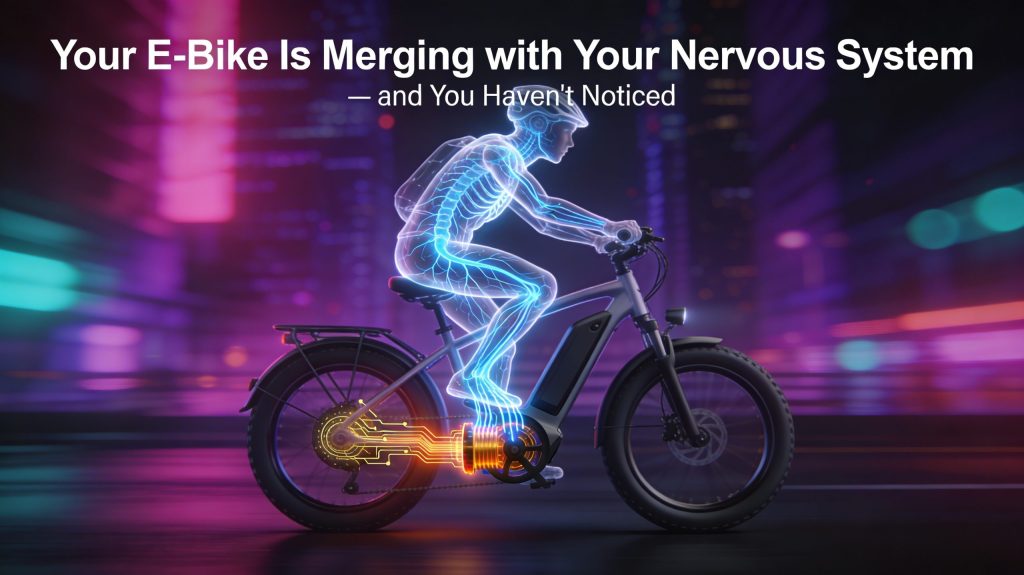

You clip in at the bottom of the hill. The light turns green. You press down on the pedal — and something else presses back.
Not against you. With you. The grade that used to make your lungs burn now just… flattens. Your legs feel the same. Your effort feels the same. But the math has quietly changed, and so have you.
We talk about e-bikes in the language of appliance specs — watt-hours, torque figures, range estimates — or we argue about whether riding one is “cheating.” Both conversations miss what’s actually interesting. Something stranger and more significant is happening between your nervous system and that motor, and almost nobody is paying attention to it.
The e-bike is not “a bicycle with a motor.” That’s like calling a smartphone “a phone with a calculator.” What it actually is — what it feels like after enough rides — is an invisible exoskeleton. An extension of your body that your brain quietly absorbs into its map of you.
This essay is about that absorption: how it works, what it changes, and why it matters far more than the wattage debate.
why this matters
If you ride an e-bike — or you’re thinking about it, or your city is building infrastructure around them — this isn’t abstract philosophy. The way these machines integrate with your body shapes how far you ride, how hard you push, what routes you choose, and what physical capacities you keep or lose over time. At the city scale, your rides generate data streams that are already being used to redesign streets and enforce rules — often without your knowledge or consent. The merger is happening. The question is whether you’re a conscious participant or a passive one.
the illusion of agency: your brain can’t tell where you end and the motor begins
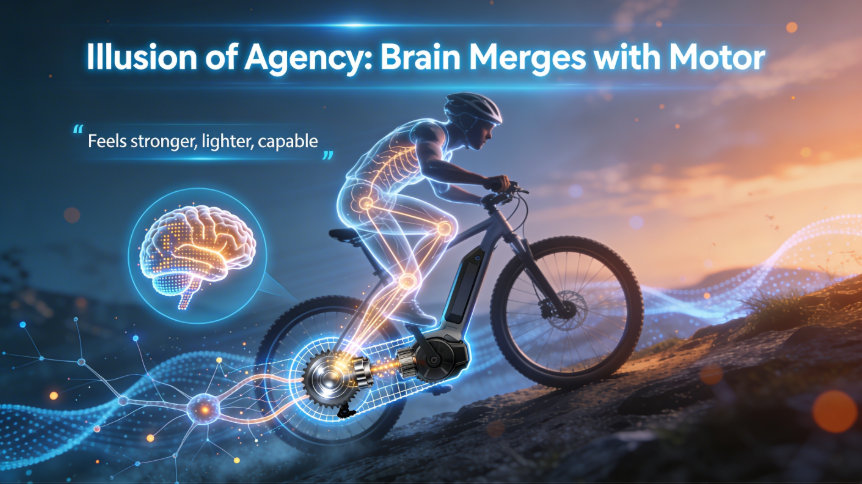
What a torque sensor actually detects
At the heart of any good e-bike is the torque sensor. Technically, it measures how hard you’re pushing the pedals. Experientially, it measures something closer to intent.
Here’s how it works: you lean into a climb and press harder. The sensor reads that increased force and delivers proportional motor power — instantly. Not after a lag. Not in a preset chunk. Proportionally, in real time, matched to your effort. That immediacy is the whole trick.
Your brain has a body map — and the e-bike hacks it
Neuroscientists use the term “body schema” to describe something most of us never think about: the brain’s continuously updated map of where your body is in space, what it can do, and where it ends. It’s the reason you can touch your nose with your eyes closed. It’s built from proprioception — the internal sense of your own position, movement, and force.
Here’s the key finding from tool-use research: when an object is in sustained physical contact with your body and responds predictably to your actions, your brain incorporates it into the body schema. The brain literally extends its sense of “self” to include the tool. This has been documented with everything from surgical instruments to prosthetic limbs. Proprioception is the mechanism that makes that plasticity possible.
Now apply that to a torque-sensing e-bike. The motor responds so seamlessly — so proportionally to your own effort — that the brain has no clean signal to separate “my effort” from “the machine’s effort.” Riders and manufacturers describe the result the same way: a “natural pedaling feel,” a “seamless transition,” a sense that the motor isn’t adding force — your legs are simply producing more of it.
Digital proprioception: when the machine disappears
This is what I call digital proprioception: the moment the e-bike shifts from an external tool you’re operating to an internalized extension you’re inhabiting. Your body doesn’t feel assisted. It just feels stronger, lighter, more capable.
This isn’t a metaphor. It reflects the same neural plasticity mechanisms documented in prosthetics and surgical-tool research — now running quietly in the background of an everyday commute.
algorithmic archetypes: the software is not neutral
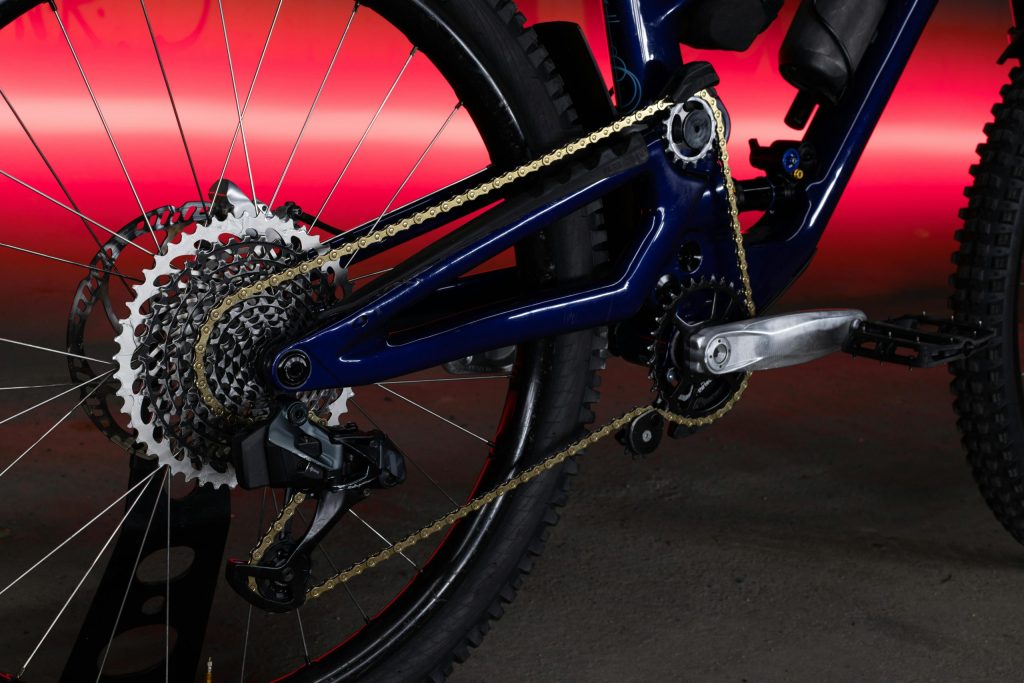
Every drive system has a philosophy
If the torque sensor detects your intent, the software decides what to do with it. And different systems do very different things — not just mechanically, but psychologically. Over time, the way a motor delivers power shapes how you ride, how you think about effort, and even how you see yourself as a rider.
- Conservative systems (e.g., Bosch-inspired): Predictable, linear power delivery. You always know what you’re getting. The ethos is discipline.
- Subtle, adaptive systems (e.g., Shimano-like): The assistance is nearly invisible. Power arrives so smoothly the boundary between you and the motor dissolves. The ethos is flow.
- Performance-oriented platforms (e.g., Specialized-style): Deep integration with metrics — heart rate, cadence, power output. Every climb gets a number. The ethos is optimization.
- Flexible, high-power options (e.g., To7motor-style): Raw, configurable responsiveness that invites experimentation and boundary-testing. The ethos is exploration.
Your software is training you
Spend six months on a conservative, linear system and you’ll internalize a different physical identity than someone trained by an adaptive, near-invisible assist. The first rider knows where the motor ends. The second rider may have forgotten.
the evolutionary question: enhancement or atrophy?
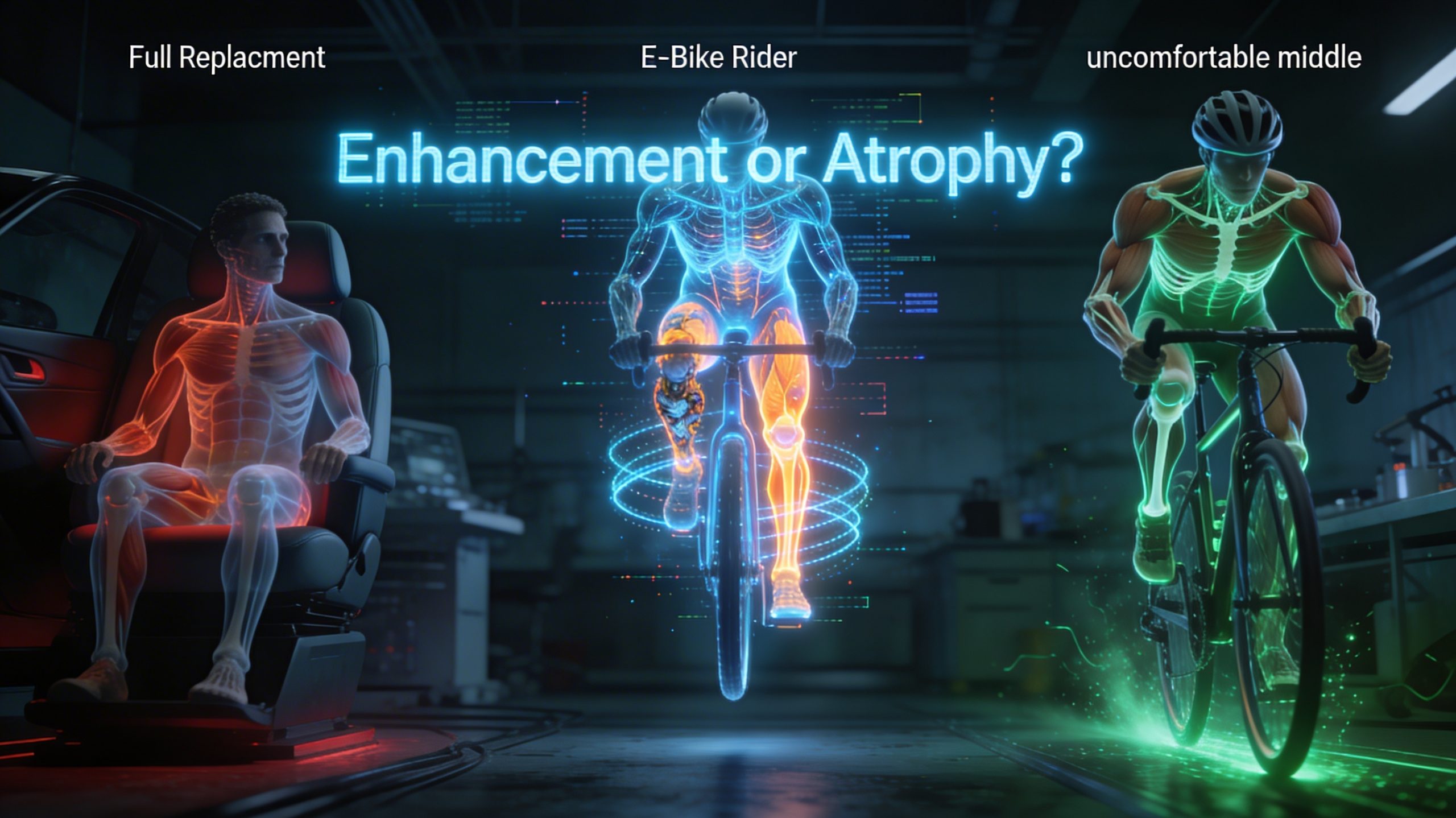
The e-bike sits in an uncomfortable middle
Does augmented mobility expand human capacity — or quietly erode it? A car answers this question simply: it replaces your legs entirely. A traditional bicycle answers it simply too: your legs do everything. The e-bike is philosophically trickier. You’re still pedaling. You’re still exerting effort. But the effort has been modulated by an algorithm, and the question of what that modulation does to your body over months and years is genuinely unresolved.
What Wolff’s Law suggests (and what we don’t yet know)
Wolff’s Law states that bone tissue adapts to the mechanical loads placed on it — use it more, it strengthens; use it less, it weakens. The principle offers a useful analogy for thinking about e-bike adaptation, though the mechanisms for soft tissue are distinct.
What existing research does show is that e-bike users travel longer distances and exert less effort per trip than conventional cyclists. What it does not yet establish is downstream adaptive atrophy. The data isn’t there yet. The question is.
When does support become replacement?
This is the tension worth sitting with. When does proportional assistance cross the line into effective replacement of capacity? The answer isn’t inherently dystopian — it depends entirely on usage patterns and awareness. But in an era increasingly shaped by algorithmic comfort, the harder question surfaces: what kinds of embodied capacities do we consciously choose to cultivate?
reclaiming sovereignty: the rise of the mindful rider

Technological determinism is not inevitable
Here’s the good news: algorithmic pull can be countered by conscious practice. And an emerging culture of riders is doing exactly that.
The deliberate toggle
In cycling forums and long-distance touring communities, a pattern has become visible: experienced e-bike commuters deliberately disable assistance on familiar routes to preserve direct engagement with physical challenge. They rotate between assisted and unassisted modes — not randomly, but intentionally, treating the motor as a threshold tool rather than a constant crutch.
These riders view the e-bike as an amplifier. It extends range. It enables inclusivity — opening cycling to people who couldn’t otherwise participate. It reclaims commutes that would otherwise be abandoned for cars. But it doesn’t replace effort by default.
The line is drawn by attention
The distinction between genuine enhancement and subtle atrophy lies precisely here: not in what the machine does, but in how consciously the rider chooses to engage with it.
the urban synapse: the street as software
Your ride is writing code
As the e-bike extends the rider’s body, it also plugs into something larger: the city’s nervous system. Through telemetry and AIoT integration, every ride generates data streams — movement patterns, air quality exposure, infrastructure utilization. Several cities, including Amsterdam and Shenzhen, have piloted programs that aggregate e-bike mobility data for real-time traffic optimization and cycling infrastructure planning.
That’s a genuine public benefit. It’s also the beginning of a problem.
Kinetic privacy: who owns your movement?
This introduces what we might call kinetic privacy — a concept that barely exists in current governance frameworks. Who owns the data generated by your physical movement through space? On what terms was it collected? Who can access it, aggregate it, or sell it?
The Core Issues
Geofencing already allows operators and municipalities to enforce speed restrictions or zone-based access limits — a power that exists largely outside public accountability frameworks. Aggregated ride data, while anonymized in principle, has repeatedly been shown susceptible to re-identification. The governance frameworks to address this remain years behind the technology.
conclusion: toward the modern centaur
Come back to that moment. The torque sensor fires. Your physical intent becomes the algorithm’s instruction. It takes a fraction of a second. It requires no conscious thought. And that is precisely why it matters.
Mythology gave us the centaur: equine power fused with human reason. The e-bike offers a contemporary, subtler synthesis — muscle and code, blended so smoothly you might never notice the seam.
But the centaur knew it was a centaur.
Unexamined reliance risks something real: the slow erosion of unmediated capacities through the accumulation of small, invisible conveniences. Not a dramatic loss. A quiet one.
Deliberate engagement looks like this: understanding how your system’s software shapes your riding. Interrogating your own physical adaptations. Advocating for ethical data governance over your movement. These choices transform the invisible exoskeleton from something that happens to you into something you master.
The sensor fires. The motor responds. What you do with that awareness is still entirely yours.
Sources
13 peer-reviewed studies, institutional reports, and academic publications