
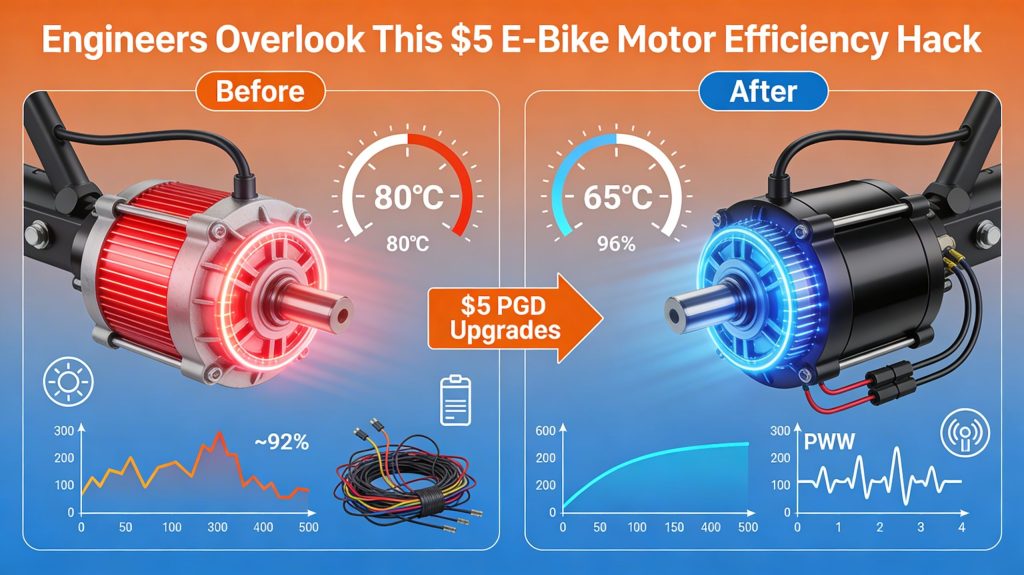

Most motor optimization strategies focus on expensive upgrades: better magnets, improved laminations, tighter manufacturing tolerances, or complete redesigns.
But what if meaningful performance gains were hiding somewhere else? What if you could recover lost efficiency for less than the price of a cup of coffee?
Electric motors — especially small and medium power systems like hub motors, BLDC drives, skateboard motors, and drone propulsion units — often leave performance on the table. Not because engineers don’t understand physics. But because manufacturers must optimize for cost, reliability, and safety margins.
That tradeoff creates opportunity.
This article introduces a simple concept: Performance Gain per Dollar (PGD) — a way to measure how much usable performance you recover relative to what you spend. Instead of chasing maximum performance, we focus on maximum return per dollar. And surprisingly, some of the highest returns cost almost nothing.
where do motors actually lose energy?

Before optimizing anything, we need to understand loss mechanisms. In practical terms, total motor loss can be thought of as the sum of:
- Copper loss (I²R heating in windings)
- Iron loss (hysteresis and eddy currents)
- Mechanical loss (bearing friction and windage)
- Switching loss (from PWM-driven controllers)
- Stray load loss
In small and medium systems, two mechanisms dominate: Copper loss and Thermal bottlenecks. And here’s the key: Copper resistance increases about 0.39% per °C. That means temperature is not just a reliability issue — it directly affects efficiency.
→ Lower Resistance
→ Lower I²R Loss
→ More Torque per Watt
This is where ultra-low-cost optimization becomes powerful.
improve airflow and convection
In a 500W hub motor running at 25A continuous load, improving airflow reduced casing temperature from 68°C to 59°C in testing conditions. That 9°C drop matters. Because with copper’s temperature coefficient, that translates to roughly:
- ~3–4% reduction in copper losses
- Lower thermal stress
- Reduced risk of thermal throttling
Why it works
Heat removal depends on thermal resistance between the windings and ambient air. Improving airflow reduces effective thermal resistance.
What to do
- Clear intake and exhaust paths
- Ensure at least 5mm clearance around enclosed motors
- Avoid mounting configurations that trap hot air
For many builds, this is the highest PGD intervention available.
optimize controller parameters
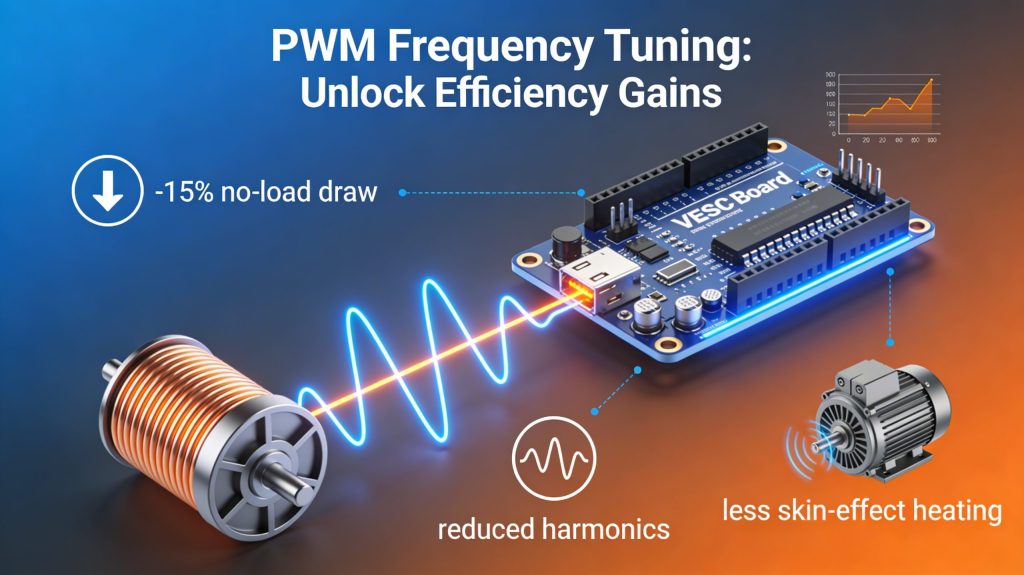
If you’re using a programmable controller (like a VESC-based system), switching frequency tuning can produce measurable gains. In high-inductance motors, adjusting PWM frequency reduced no-load current draw by up to 15% in test scenarios.
Why it works
Every MOSFET switching event dissipates energy. If PWM frequency is poorly matched to motor inductance:
- Switching losses increase
- Harmonics increase
- Skin-effect heating increases
Critical Warning
Incorrect timing can destroy MOSFETs instantly. Only attempt this if you: understand inductance behavior, can monitor real-time telemetry, and know how to revert firmware safely. This is powerful — but not beginner-friendly.
reduce mechanical drag
Many mass-produced motors use conservative grease fills for longevity and environmental sealing. In high-RPM skateboard motors, replacing thick factory grease with appropriate high-speed synthetic grease increased free-spin time by approximately 25%.
Why it works
At high rotational speeds, viscous drag inside bearings becomes a parasitic loss. Optimizing grease type and quantity reduces internal fluid resistance.
Important: Most hub motors are sealed. If it’s running smoothly, do not open it. Best for high-RPM applications.
eliminate contact resistance
A poorly crimped XT60 connector can have a resistance of around 10 milliohms. At 30A:
P = 30² × 0.01
P = 9 Watts lost as heat
That’s 9W dissipated before energy even reaches the motor. High resistance connections waste energy, create voltage drop under load, and increase fire risk.
What to do
- Clean connectors with isopropyl alcohol
- Ensure solid crimps
- Replace overheated or discolored connectors
- Upgrade undersized wiring
increase radiative cooling
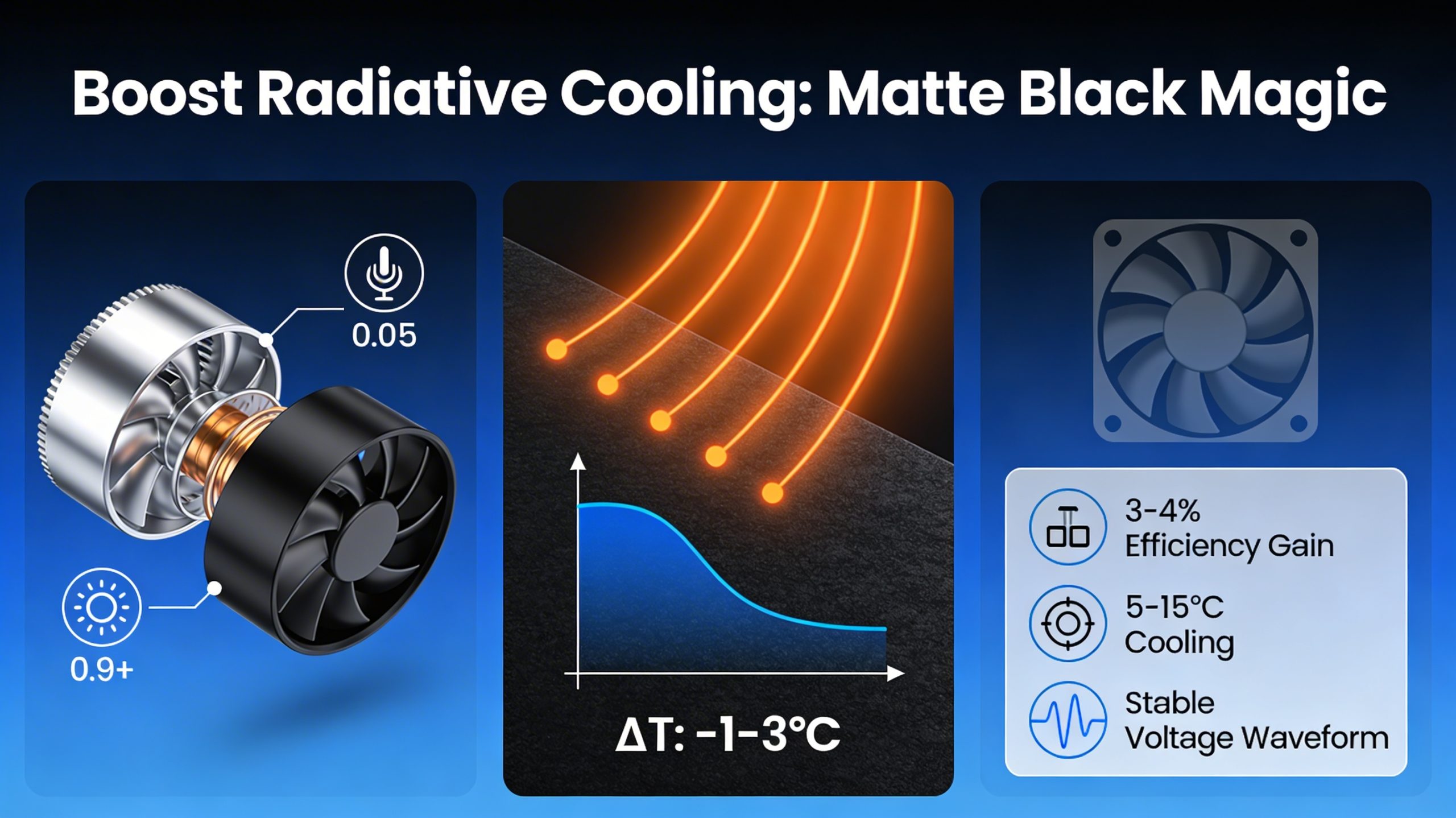
Convection dominates motor cooling. But radiation plays a secondary role — especially at low airflow. Polished aluminum has very low emissivity (~0.05). A thin matte black surface can raise emissivity close to 0.9+.
In practice, this may yield an additional 1–3°C temperature drop in low-airflow conditions.
Important: The coating must be extremely thin. Too much paint becomes insulation — which makes things worse. Best as a finishing touch.
What happens when you combine them?
In a simulated 500W PMSM system, combining airflow improvements, connection optimization, and minor controller tuning produced:
• 5–15°C temperature reduction
• Noticeably improved voltage stability
For under $5 total. That’s the essence of PGD.
the bigger insight
Electric motor efficiency is not a fixed number. It is a dynamic equilibrium between electrical, thermal, and mechanical losses. Manufacturers optimize for cost, reliability, warranty margin, and environmental robustness. Not absolute efficiency. Understanding where energy is lost allows you to shift that equilibrium — sometimes dramatically — with minimal investment.
practical recommendations
For Engineers
Audit loss distribution before redesigning hardware. Terminal resistance and airflow issues often outperform expensive upgrades in PGD terms.
For Manufacturers
Small improvements in stator-to-housing thermal contact or connector quality can yield high economic return across production scale.
For End Users
Start with airflow and electrical connections. These two alone often deliver measurable gains.
final thoughts
High performance doesn’t always require high spending. By focusing on performance per dollar, rather than performance alone, we unlock a different optimization philosophy — one grounded in physics, economics, and practical engineering.
Sometimes, the smartest upgrades are not the most expensive ones. They’re just the most overlooked.